Community Transportation Research Lab (CTRL)
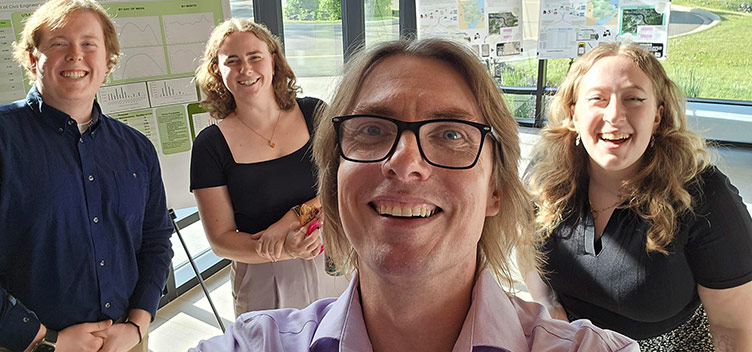
Dr. Hanson and his research team presenting research findings on location
There is a need for more research in Canada on the transportation planning needs outside of the largest urban centres, where automobile dependence is high but the availability of sophisticated transportation planning tools and data to support the development of other modes (like transit) is limited.
Improving transportation planning practices
The Community Transportation Research Lab (CTRL) aims to change this by bringing an engineering lens to partner with communities to help improve their transportation planning practices, with the goal of supporting effective alternatives that can help reduce our dependency on cars while maintaining or enhancing personal mobility.
CTRL focuses on the issues facing smaller urban areas (< 200,000 people), and regional and rural areas. It is currently working in four key areas in transportation research:
- Small city, regional and rural transport planning (including active transportation and transit)
- Accessible and on-demand transportation and the built environment
- Post-secondary education travel demand and tourism and employment travel demand
- Older adult health transportation travel demand
Leveraging university settings for new ideas
The CTRL at the University of New Brunswick (Fredericton) is inspired by other Canadian transportation research labs that leverage their location within a university setting to explore new research ideas developed through partnerships.
The CTRL aims to partner with transportation planning entities within regions and municipalities and involve public, private and non-profit sector transportation providers. It brings together data from partners where innovative analysis techniques will help lead to new discoveries from existing data.
It will help look at “what-if” scenarios, including developing the models and analysis to support these scenarios. It will help collect more data in areas where data is limited, and study datasets that have yet to be fully analyzed for transportation planning purposes.
Student trainees will form the core of the Lab, with small-scale projects undertaken by BScE students, with progressively more complex research being undertaken by MEng, MScE and PhD students.
Research publications
Papers
The following research papers have been presented at conferences or published in journals relevant to community transportation.
- Measuring the "Age-Friendliness" of a Community: Evaluation of Audit Guides for Supporting Engineering Decision-Making (2025)
- A Tale of Two Bridges: Using the 4-Step Model to Understand Active Transportation Usage Across the Wolastoq/St. John River in Fredericton, NB (2023)
- Operational Planning for Health Transport of Older Adults in New Brunswick (2023)
- Exploring Agent-Based Modelling for Car-Based Volunteer Driver Program Planning (2022)
- Four-Step Modelling Active Transportation For Small Cities: Challenges And Opportunities (2022)
- Will Cyclists use it? Applying Regression Models for NCHRP Report 941 to Score Cycling Routes for Comfort, Safety and Willingness to Try (2022)
- Learning from rural innovation: What can volunteer driver programs teach us about planning for autonomous vehicles? (2019)
- Developing Transportation Engineering and Planning Metrics for Rural Volunteer Driver Programs (2019)
- Understanding the supply of and demand for volunteer driving in Canada: Knowledge sources, gaps and proposed framework for future research to support transportation planning for older adults (TRB, 2018)
- How many New Brunswickers rely on organized volunteer driver programs? Preliminary tools and approaches to help us find the answer (2017)
- Exploring the past 70 years of transportation planning tools and practices among select New Brunswick cities: Are we ready for the future? (2017)
- Enabling and measuring success among New Brunswick volunteer driver programs in an era of demographic change: Towards a common data collection standard (2016)
- Issues and opportunities for enhancing active transportation among rural and urban areas: lessons from a New Brunswick study (2015)
Reports
About us
Our team
Dr. Trevor Hanson, P.Eng, Professor of Civil Engineering
Coordinator, UNB Transportation Group & CTRL
thanson@unb.ca | LinkedIn | Profile
Dr. Apoorva Rathod, Post doctoral fellow
Hometown: Moncton, NB
Degree and year: PhD, 2022
Research Interest: Mobilities and transport; transport planning; social justice; differentiated mobilities; transport and health.
Daniel Higdon
Hometown: Corner Brook, Newfoundland and Labrador
Degree and year: Going into first year of M.ScE
Research interest: Developing thesis for M.ScE while working on various smaller projects.
LinkedIn
Han Pham
Hometown: Saigon, Vietnam
Degree and year: Going into fourth year of BScE Civil Engineering
Research interest/ report topic: Active transportation and mobilizing healthy urban city policies.
Ayush Bhosale
Hometown: Kolhapur, India
Degree and year: BSc Computer Science - fourth year
Project: CampusMoveNB
Ahmed Mamoon Faheem
Hometown: Islamabad, Pakistan
Degree and year: Master of Engineering (MEng) in Civil Engineering, first year
Research interest/ report topic: An active transportation data collection plan for the southeast region of New Brunswick.
LinkedIn
Priscilla Mensah-Aborampah
Hometown: Ashanti Region, Ghana
Degree and year: Master of Engineering (MEng) Civil Engineering, first year
Research interest/ report topic: Regional travel demand modelling strategy to support transportation planning in New Brunswick Regional Service Commissions
LinkedIn
Ekene Splendor Ijeh
Hometown: Delta State, Nigeria
Degree and year: Master of Science in Engineering (MScE), first year
Thesis topic: Feasibility study: Cellphone data for healthcare-related travel demand analysis
LinkedIn
Partners and funding
CTRL partners include those that provide funding support for lab activities (foundational partners) and those that provide in-kind support (supporting partners).
Funding includes research grants to support specific research projects led by Dr. Hanson
Foundational partner: Southeast Regional Service Commission (SERSC)/Commission de Services Regionaux Sud-Est
CTRL is assisting the SERSC with meeting the goals and objectives of its Transportation Strategic Plan including projects in:
- Small city, regional and rural transport planning (including active transportation and transit)
- Accessible and on-demand transportation and the built environment
- Post-secondary education travel demand and tourism and employment travel demand
- Older adult health transportation travel demand
Dr. Hanson also has research projects funded through an NSERC Discovery Grant, the Regional Development Corporation of New Brunswick and Transport Canada.
Canadian research labs
The following is a partial list of university research labs in Canada focused on transportation engineering and planning research (organized east to west).