Climate change in food systems

As crop and livestock production are both dependent on and influenced by weather and climate, fluctuations in temperature and precipitation greatly impact agricultural practices. Rising temperatures can cause heat stress in plants, reducing their growth and productivity.
For example, prolonged periods of high temperatures can cause crops like potatoes and apples, which are staple products in New Brunswick, to mature too quickly, resulting in smaller yields, and lower-quality produce.
Additionally, unpredictable weather events, such as early frost or unseasonable heatwaves, can damage crops at crucial growth stages, further compromising yields.
Another significant concern is the increased prevalence of pests and diseases due to milder winters and longer growing seasons. Warmer temperatures allow pests and diseases to survive and flourish, posing a continuous threat to crops.
Farmers in New Brunswick must adapt by implementing integrated pest management practices and investing in resistant crop varieties, which can be both expensive and challenging to implement.
Furthermore, climate change affects the fisheries sector, which is vital to New Brunswick’s economy and food supply.
Rising ocean temperatures and changing sea levels disrupt marine ecosystems, affecting fish populations and distribution. The combined effects of reduced crop yields, compromised livestock, and fisheries productivity, directly impact food availability in New Brunswick.
Watch the video or read the video transcript. You can turn on video subtitles using the [CC] button in the bottom right corner of the video or open the video transcript.
Prefer text?
Read the transcript
Farmers and scientists know the impacts of floods, droughts, and fire which are becoming more frequent. Climate change is one of our greatest challenges.
But there are solutions, and the Canadian government has set a clear goal to cut emissions by more than 30% by 2030 and reach net zero by 2050.
Indeed, farmers are stewards of the land, and in collaboration with Canadian scientists, they are well-positioned to provide some of these solutions.
It's why the Agricultural Climate Solutions Program was developed a new program to help harness the natural power of the soil to store carbon and keep it out of the atmosphere. It will help develop effective, practical, and economic solutions to help combat climate change.
Agricultural Climate Solutions will use the same collaborative on-farm approach used by the Living Laboratories initiative. It will create collaboration hubs, including researchers, agricultural associations, farmers, environmental organizations, Indigenous groups, and others. This collaboration will lead to the co-development and sharing of sustainable farming practices.
These practices have the potential to trap and store carbon on farms reduce greenhouse gasses, improve water and soil quality, and protect the diversity of soil organism, plants, and animals on farms.
Because of this unique on-farm approach, environmentally friendly innovations suited for today's agriculture can be tested and deployed quickly to farms across Canada.
Be part of a powerful nation-wide network that will deliver the right solutions across the country to help farms and Canadians.
This program is for agriculture industry associations, not-for-profit environmental organizations including cooperatives, and Indigenous groups who are working in collaboration with producers. Be a part of Agricultural Climate Solutions.
Impacts of agricultural practices on climate
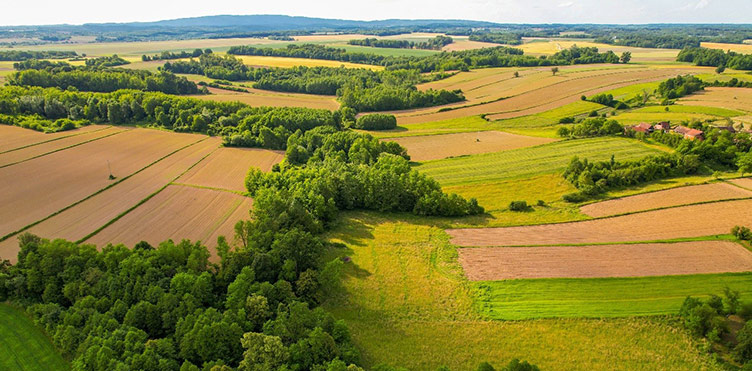
Just as weather and climate affect agricultural practices, management of our croplands and livestock is essential for addressing climate change, especially as food systems account for roughly one-third of GHG.
GHG are produced in significant quantities from agriculture activities, including livestock rearing, production of fertilizer, and land use change, whereby carbon dioxide, methane, and nitrous oxide are the largest emitted gasses. Land use change for agriculture accounts for 18% of the global GHG emissions and agriculture activities account for 15%.
Substantial changes are needed in the agricultural sector to reduce GHG, lower the environmental impact and create solutions for sustainable practices.
Climate-smart agriculture
Continual drive for production to meet the world’s needs while shifting agricultural practices towards a sustainable approach is not only desired by some but demanded by the world as climate change influences agriculture production.
In Section 2: Farming Practices in New Brunswick, we learnt about agricultural intensification, the practice of utilizing agriculture land that already exists to increase yield. While beneficial for maximizing yield, it has shown negative effects on the environment.
An enhanced system of this, known as Sustainable Agriculture Intensification, has come about to encourage production from existing farmland whilst minimizing pressure on the environment. This includes utilizing Integrated Pest Management (IPM), managing for biodiversity and for the whole ecosystem.
Other advancements to shift the agricultural sector towards more sustainable practices include transitioning from synthetic nitrogen to biological nitrogen, reducing intensive tillage, incorporating cover cropping, and crop rotation, all contributing to soil carbon sequestration.
An alternative to the natural release of methane from livestock manure into the atmosphere is the biodigester, a system that converts farm waste into renewable energy and fertilizer.
References
Learn more
- Agriculture Programs. Government of New Brunswick.
- Climate change impacts on agriculture. Jan. 31, 2020, Government of Canada.
- Impacts on ecosystems and fisheries. 2019, Government of Canada.
- Sustainable Crop Production Intensification (SCPI) in FAO. 2026, Food and Agricultural Organization of the United Nations.
- Adapting crops to rising temperatures: Understanding heat stress and plant resilience mechanisms. 2025, Kumar, A., Muthuramalingam, P., Kumar, R., Tiwari, S., Verma, L., Park, S., & Shin, H. International Journal of Molecular Sciences, 26(21), 10426.
- Climate Change and Food Systems. 2023, Mirzabaev, A., Olsson, L., Kerr, R. B., Pradhan, P., Ferre, M. G., & Lotze-Campen, H. Science and Innovations for Food Systems Transformation, 511–529.
- Carbon sequestration agriculture: A pathway to climate-resilient and sustainable farming. 2025, Munna, M. N. H. Earth Review.
- Feeding a hungry planet. 2016, Sustainable Development Solutions Network. SDG Academy.

This work is licensed under a Creative Commons Attribution-NonCommercial 4.0 International License.