About the Children’s Centre
Since 1975, the Children’s Centre has served as a demonstration site for the Education program and a research hub for curriculum development, including the first NB Kindergarten Curriculum and the New Brunswick Curriculum Framework for Early Learning and Child Care – English (2008).
Program highlights
Classroom educators, student teachers, and early childhood professors contribute to the classroom curriculum creating a unique and personalized environment for your child.
Literate play and playfulness
Children’s play fosters literacy by encouraging expression through speaking, writing, art, and movement.
Educators support this by introducing diverse texts and documenting learning experiences to share with families.
Cultivating wonder and participation in the outdoors
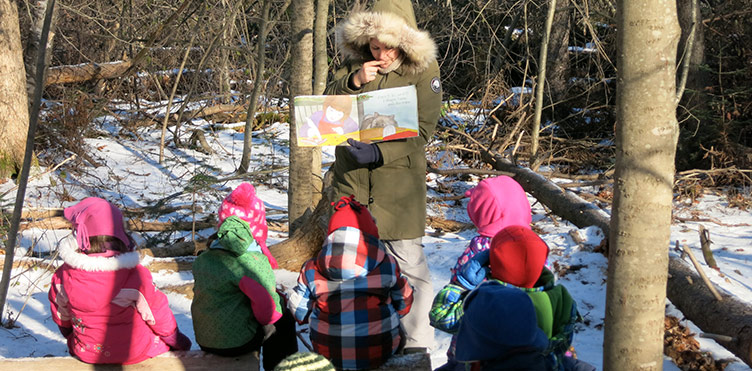
We venture outside in all weather, thanks to durable waterproof seasonal wear.
In fact, the Centre was awarded funding from TD Bank to purchase yellow waterproof splash pants and waterproof mittens to ensure all children can enjoy outdoor learning.
Outdoors, children engage in dramatic play, music, storytelling, art, mapping activities, and the study of plants, animals and insects.
Our playground and garden
The playground is a large, natural space, south-facing and partially sheltered from the wind, creating a comfortable environment for year-round play.
Children also plant and harvest vegetables and flowers in our garden, sometimes even enjoying their harvest during snack time.
Inclusion and diversity policy
We recognize that each child embodies race, religion, culture, language, social and economic status, gender, sexual orientation, and ability in unique and dynamic ways, we acknowledge that paying close attention to these differences ensures equitable access and opportunities for children and their families.
We enact a curriculum that is responsive to differences, with a capacity to provide additional support as required to ensure each child’s right to full participation. We enact respectful and responsive relationships work to ensure a sense of belonging and community among children, educators, and families.