

In Canada’s only officially bilingual province, language rights have long occupied a central place in public life—shaping political debate, constitutional litigation, and the everyday realities of communities across New Brunswick. For Prof. Bruno Gélinas-Faucher, those questions are not merely academic; they sit at the heart of an ongoing legal and constitutional struggle over how minority communities are protected, empowered, and sustained for generations to come.
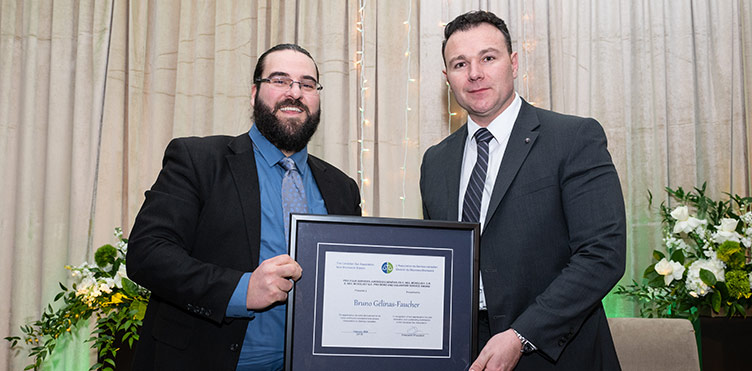
This February, Prof. Gélinas-Faucher was recognized with the 2026 E. Neil McKelvey, Q.C. Pro Bono and Volunteer Service Award by the CBA New Brunswick Branch for his work defending the language rights of New Brunswick’s French-speaking communities, particularly in litigation surrounding the Vitalité Health Network.
For Gélinas-Faucher, the award is not a culmination so much as a marker along a continuing path—one shaped by the evolving meaning of equality in New Brunswick. His advocacy in the Égalité Santé case, which challenged government decisions affecting the governance of the francophone health network, reflects a career built on the conviction that constitutional promises must be lived, not merely declared.
“I am deeply honoured by this recognition,” he says. “The award signals the broader importance of language rights work and affirms that this area of law remains both vital and unfinished. Protecting linguistic minority communities requires sustained legal engagement, and pro bono constitutional advocacy plays a crucial role in ensuring those voices are heard.”
Gélinas-Faucher’s interest in language rights did not begin in New Brunswick, but it found its clearest expression there.
“I have long been drawn to constitutional law, and to Charter rights in particular,” he explains. “That interest began early on through clerking and legal practice, including during my clerkship at the Supreme Court of Canada, where I worked on language rights cases. Those experiences grounded my understanding of language rights as a core part of Canada’s constitutional framework, not a peripheral concern.”
It was his move to the province in 2022 that sharpened that understanding into something more immediate and concrete.
“Being in the only officially bilingual province, and in a context where language rights are both constitutionally entrenched and actively lived, brought the stakes of these protections into much sharper focus,” he says. “It is here that I became deeply involved in language rights litigation.”
In New Brunswick, language rights are not abstract commitments. They are embedded in schools, hospitals, courts, and public institutions that shape daily life. For Gélinas-Faucher, that proximity between law and lived experience has made the field both intellectually compelling and socially urgent.

To understand his work, Gélinas-Faucher explains, one must first understand what language rights actually are in Canada’s constitutional order.
“Language rights in Canada are not a symbolic add-on to the Constitution—they are part of the country’s foundational architecture,” he says. “They reflect a historic commitment to protecting minorities in a way that goes beyond simple majority rule.”
Unlike many Charter protections, language rights operate simultaneously at the individual and collective level. They guarantee personal access to services and institutions while also sustaining the vitality of linguistic communities themselves.
Their significance becomes tangible, he explains, when placed in everyday contexts: “They determine whether a parent can send their child to a school that preserves their culture, whether a patient can understand a medical consultation, whether an accused person can follow court proceedings, or whether citizens can meaningfully participate in democratic life.”
These are not abstract privileges; They are the conditions under which equality, dignity, and participation become real.
The Égalité Santé case centred on section 16.1 of the Canadian Charter, a provision unique to New Brunswick that constitutionally recognizes the equality of the province’s two official linguistic communities. Section 16.1 gives constitutional status to a foundational New Brunswick statute adopted in 1981: the Act Recognizing the Equality of the Two Official Linguistic Communities.
“At its core,” says Gélinas-Faucher, “the case asked how far governments must go—not merely to treat English and French speakers the same in a formal sense, but to actively protect the distinct institutions that allow each linguistic community to flourish over time.”
Both section 16.1 and the Equality Act are grounded in the idea that linguistic communities are not protected in the abstract. They are protected through the institutions that allow them to exist, develop, and reproduce themselves over time.
“The constitutional guarantee is therefore not limited to language as a means of communication; it is tied to the preservation and promotion of the institutional spaces that sustain community life. Without such institutions, equality between linguistic communities risks becoming purely symbolic.”
This institutional dimension, Gélinas-Faucher explains, was central to the Égalité Santé case because the government decision under review directly affected the governance of the Vitalité health network.
“By eliminating the elected board of directors—whose majority of members were chosen by the francophone community—the decision removed a key mechanism through which the community exercised meaningful control over an institution it had historically built and developed from the ground up. The Court recognized that this form of community governance was not incidental, but essential to the role Vitalité plays for the francophone and Acadian community.”
The judge accepted that Vitalité is not simply a health-care service provider, but a structuring institution that contributes to the linguistic, cultural, educational, and economic vitality of the community. Its governance model was found to be closely tied to that role, reflecting the community’s historical efforts to create and sustain institutions capable of meeting its specific needs.
According to Gélinas-Faucher, the case also raised a crucial question about administrative decision-making and positive measures. It confirms that when governments make decisions affecting institutions essential to the vitality of a linguistic community, they must do more than invoke general policy objectives.
“Decision-makers are required to seriously consider the impact of their actions on the protection and promotion of linguistic communities and to give real effect to the obligation of positive measures set out in the Equality Act and reflected in Charter values. In that sense, the case is not only about Vitalité itself, but about how governments must approach institutional decisions that shape the future of minority language communities.”
Litigating such a case, Gélinas-Faucher notes, required more than doctrinal argument. It required an understanding of how law interacts with identity and culture.
“From the outset, it was clear that this case could not be approached as a purely technical legal dispute,” he says. “Language rights sit at the intersection of law, identity, and culture, and that reality shaped both the legal strategy and the evidence we presented.”
To understand what was truly at stake, the Court needed to see how institutions like Vitalité function within the lived reality of the francophone and Acadian community.
The case relied on interdisciplinary sources—sociology, history, and economics—to demonstrate how institutions like Vitalité function within community life.
“The question was not simply whether services could be delivered in French, but whether the community retained the institutional capacity to sustain itself and to shape its own future.”
That framing echoed section 3 of the New Brunswick Equality Act, which requires governments to take positive measures to promote the cultural, economic, educational, and social development of linguistic communities.
Behind the legal arguments lies a deeply personal dimension: the awareness that constitutional litigation is both rare and consequential.
“Constitutional litigation of this kind is a one-shot moment,” Gélinas-Faucher says. “You rarely get a second opportunity to clarify the meaning of a provision like section 16.1 once the courts have spoken.”
That reality creates a form of responsibility that extends beyond the parties before the court.
“You have to get it right, not only for the immediate parties, but for future generations who will live with the precedent.”
At times, that responsibility becomes visible in unexpected ways.
“Members of the public wrote letters, spoke about the case in the media, and came to attend the hearings simply to thank the legal team for the work being done,” he recalls. “That level of engagement was deeply moving, but it also underscored the responsibility we were carrying.”
The impact of the Égalité Santé decision, Gélinas-Faucher argues, extends well beyond a single institution. It contributes to a broader shift in how courts understand language rights in Canada.
“This case has helped clarify—and strengthen—the understanding that constitutional language rights in Canada are not confined to language use alone, but are deeply connected to the institutions that allow linguistic communities to thrive.”
It also reinforces a more demanding standard for government decision-making.
“Government decision-making must actively take into account the promotion and protection of official language communities,” says Gélinas-Faucher. “In New Brunswick, this obligation is expressly set out in the Act Recognizing the Equality of the Two Official Linguistic Communities, but until now it had never been used in a concrete way to challenge a government decision with such significant impacts on a linguistic minority.”
The case moves language rights away from symbolic recognition and toward practical, enforceable standards that governments must respect when exercising their powers.
Indeed, the broader shift reflected in the Égalité Santé decision is already shaping other constitutional litigation involving government decisions affecting linguistic minority communities. Similar questions are now arising in the ongoing Forum des maires de la Péninsule Acadienne case concerning courthouse closures in the Acadian Peninsula, another matter in which Gélinas-Faucher is involved and which may ultimately require clarification from the Supreme Court of Canada.
Even as the Égalité Santé case continues to shape doctrine, Gélinas-Faucher is already looking ahead to the next frontier: the scope of section 16.1 and the meaning of “distinct institutions.”
“The question is not only which institutions are protected under section 16.1, but also what that protection entails,” he explained. “In particular, it raises the issue of whether constitutional protection includes a right of community control and management over those institutions.”
The comparison he draws is deliberate. In education, the Supreme Court has already recognized that minority language rights require meaningful community control. Whether that principle extends to other institutions remains unresolved.
For Gélinas-Faucher, the E. Neil McKelvey, Q.C. Award is closely tied to questions of access to justice. Much of his constitutional litigation is done on a pro bono basis, a choice he sees as integral to the functioning of the legal system in this area.
“Many issues of fundamental constitutional importance—particularly those affecting minority communities—would simply never reach the courts without that kind of commitment,” he says. “Access to justice in this area often depends on the willingness of lawyers and scholars to step in where resources are limited.”
The award, he adds, is also a reflection of his role as an academic engaged in practice.
“As academics, we often critique decisions and argue that the law should evolve or be applied differently. I see this work as a way of moving beyond critique in the abstract and engaging concretely in that evolution.” That practical experience, he notes, also informs his teaching, allowing students to engage with constitutional litigation not only as doctrine, but as a lived and evolving process unfolding before the courts.
He hopes the recognition will signal something broader about the field itself— not as an endpoint, but as a reaffirmation of responsibility.
“I hope the award signals the importance of language rights work more broadly, and recognizes that this area of law remains both vital and unfinished.”
For Gélinas-Faucher, constitutional law is not a fixed set of answers, but an ongoing negotiation between institutions, communities, and the promises embedded in Canada’s constitutional order. That negotiation continues in the evolving life of a bilingual province still defining what equality between its linguistic communities truly requires.