
Some areas of the law leave little distance between decision and consequence. Criminal law is one of them, where rulings land in real time and can have a significant effect on people—often at the most consequential moments of their lives.
For the Hon. Scott Brittain (LLB’03), this is the daily work of a provincial court judge: weighing competing principles and interests, confronting human complexity, and making decisions that can alter the trajectory of a life.
“It is a very serious responsibility,” he says plainly. “You’re dealing with people’s liberty, and you’re deciding matters that will inform their future.”
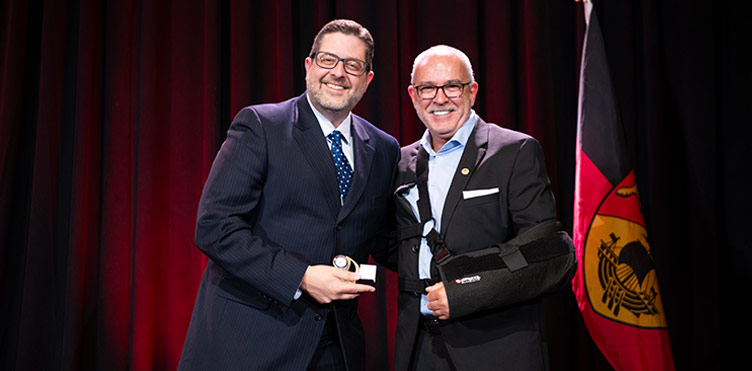
It is this responsibility—measured, human, and unavoidably difficult—that sits at the centre of Judge Brittain’s career, and at the heart of his recognition as a 2026 recipient of the Proudly UNB Alumni Award of Distinction.
Judge Brittain’s path to the bench began, fittingly, at UNB Law—the only law school he applied to.
“I think it was the reputational draw, the small class sizes, the collegial dynamic,” he recalls. “There were a lot of positives that drew me to it.”
After completing his undergraduate degree at UNB Saint John, law school felt like a natural next step. A background in history and politics provided a conventional foundation, but his decision was also shaped by something more intuitive: a sense that the law offered both challenge and flexibility.
“I always felt that perhaps I had some aptitude for the practice of law,” he says. “But what I liked was the diversity—a law degree opens a lot of doors, even if you don’t end up practicing.”
At UNB Law, that potential began to take shape. Professor David Townsend left a lasting impression—not only through his teaching, but through his mentorship.
“Prof. Townsend really stands out to me. He was a very engaging professor, and his teaching style resonated with me. He was also a great mentor. He taught me administrative law and real property law, using the old-school Socratic method that was more common at the time. He had a real impact on my development.”
That combination—rigour in the classroom and support beyond it—would become a defining influence on Brittain’s own approach to the profession in the years that followed.
After graduating, Brittain began his legal career in Toronto, summering and articling at Bennett Jones. In many ways, it was a classic move: a young lawyer testing his skills in a large firm, in a major market. But it didn’t take long for him to realize that his future lay elsewhere, closer to home.
“It was a positive learning experience,” he says. “The firm was great, and the people were top-notch, but Toronto wasn’t a place I saw myself staying long term.”
He returned to New Brunswick, working in Stewart McKelvey’s litigation group in Saint John for three years before moving into public service—a shift that would go on to shape the rest of his career. At the City of Saint John, Brittain found what would become a constant throughout his career: breadth of experience.
“It was a small department with a principled leader in John Nugent, K.C., and there was a lot of work,” he explains. “Given the fiscal circumstances at the time, we didn’t have the luxury of farming things out. Our outside counsel budget was peanuts. If something needed to be done, you did it. If you didn’t know it, you learned it.”
The result was early front-line exposure to litigation, labour arbitrations, and administrative law work—the kind of experience that sometimes takes longer to gain in a more stratified large-firm environment.
After more than a decade with the City, Brittain made the move to NB Power—what he describes as a “full-circle moment.”
“The newly hired general counsel at NB Power was fellow UNB Law grad Jamie Petrie (LLB’94). He taught me at UNB Law, and I later worked with him at Stewart McKelvey. It was wonderful to work with Jamie again, as well as the other members of NB Power’s legal department.”
At NB Power, Brittain’s versatility quickly became an asset in his role as senior solicitor.
“They used to call me the ‘utility player,’” he says with a laugh. “They gave me a wide range of files, and I’d just run with them. I was doing all kinds of things—litigation, labour and employment, procurement, contract negotiation and drafting—you name it.”
It was demanding work—fast-paced, varied, and driven by the operational realities of a large public utility.

By the time Brittain applied to become a provincial court judge, public service had become a central thread in his career.
“I had been a public servant for most of my career,” he says. “And I saw the judiciary as an opportunity to serve the public in a different way.”
He applied just before the disruption of the COVID-19 pandemic, and the call came in early 2022 to fill a vacancy in Miramichi. What followed was less a transition than a transformation. Brittain had a few weeks to wrap up his practice, establish a residence in a new location, and ready himself for the challenges ahead.
Despite nearly two decades of legal experience, Brittain describes his appointment as “unconventional” and the learning curve as significant.
“The overwhelming majority of people who serve as provincial court judges have been either Crown prosecutors or criminal defence lawyers—people who, for the most part, have had significant experience in criminal law. That wasn’t me,” he explains. “There was a big learning curve.”
Provincial court, often described as the “engine room” of the criminal justice system, handles the vast majority of cases in Canada. The pace is relentless, the subject matter urgent, and the expectations immediate.
“You’re making decisions that matter in real time,” he says. “There’s no long runway.”
The early months required full immersion: long days (and nights), weekends, and an intense effort to absorb a largely new area of law. What made the transition possible, he notes, was collegiality.
“There’s a perception sometimes that the judiciary is solitary,” he says. “But that hasn’t been my experience. There are generous colleagues and a lot of knowledge sharing. That mutual support is critical.”
Four years in, he describes the learning curve as “very much ongoing”. Brittain states, “I am often asked if I feel more comfortable each day, and my response is always the same—each day I feel slightly less uncomfortable.”
The weight of sentencing and the need for humanity in a high-volume systemIf the learning curve was steep, the responsibility was steeper still. For Brittain, the most meaningful—and most difficult—aspect of the role lies in sentencing.
“The Supreme Court of Canada has said it’s one of the hardest tasks judges perform,” he notes. “And that’s absolutely true.”
Sentencing is enshrined in the Criminal Code and in case law. It’s not a mechanical exercise. It requires balancing competing principles: denunciation, deterrence, rehabilitation, and proportionality. It demands attention not only to the offence, but to the offender.
“You’re dealing with people who often have multi-layered challenges,” he says. “Homelessness, addiction issues, mental health difficulties, unresolved trauma—sadly, those things are very common.”
Pre-sentence reports often reveal histories shaped by instability: childhood neglect, exposure to violence, systemic barriers. For Brittain, these issues don’t excuse the behaviour but inform how you understand it—and how you respond to it. The task, then, is not simply to punish, but to craft a response that serves justice in a broader sense.
“You’re trying to determine a fit and appropriate sentence,” he explains. “One that meets the needs of the system but also recognizes the offender’s circumstances and accounts for victim and community impact. That balance is not always easy. There are times when you can see that someone is at a fragile fork in the road,” he says. “And the decision you make may very well influence whether they go in a pro-social or pro-criminal direction from there.”
The challenge is compounded by the realities of provincial court: volume, pace, and constraint. Brittain notes that over 99 percent of criminal matters are dealt with in provincial court—from the mundane to the very serious. That means decisions must often be made quickly, even when the stakes are high.
“You’re trying to move along a lot of cases,” he says. “But you never want it to feel like an assembly line.”
That, he suggests, is one of the central tensions of the role: maintaining a sense of humanity within a high-volume system that requires the judge to move quickly.
“What a horrible thing it would be,” he reflects, “for offenders and victims to come through the system and feel like they weren’t really seen or heard. It’s critical to do right by people. There is a lot of truth in the old quote that ‘people will forget what you said, people will forget what you did, but people will never forget the way you made them feel.’”
Avoiding that outcome requires not only legal skill, but presence—an awareness that each case involves people and is “not just another file”.
One of the most complex aspects of sentencing involves understanding context - particularly in cases involving Indigenous individuals, who remain significantly overrepresented in the criminal justice system.
“There are historical and systemic factors that have to be considered,” Brittain says. “That’s part of the framework we work within. You’re applying legal principles,” he says, “but you’re also trying to understand how someone arrived at that point, and what might help them move forward.”
It is, in many ways, a dual responsibility: to uphold the law while engaging seriously with the human realities behind it, and to consider the restorative and rehabilitative dimensions.
In the end, Brittain resists framing his role in grand terms. Instead, he returns to the practical realities of the work: the cases, the decisions, the people. Each day brings new facts, new circumstances, and new judgments to be made, together with an ongoing effort to “get it right.”
“It’s challenging,” he says. “But it’s meaningful. You’re always learning, always trying to do better.”
“Both of my parents came from backgrounds of public service,” Brittain says. “My father was an elementary school teacher, and later a principal, and my mother is a retired nurse. So that commitment to service, I think, permeated me. What I didn’t inherit, I absorbed by osmosis through my different roles.”
That same commitment extends beyond the courtroom. Brittain is a former president of the Saint John Law Society, the CBA-NB, and the Law Society of New Brunswick—a role he served during the start of the COVID-19 pandemic.
“There was intense pressure in those early days,” he says. “People were very worried about how their practices were going to survive, and there was a lot of uncertainty. The sky was falling.”
The role quickly became all-consuming. “Those first few months were essentially a full-time job on top of a full-time job,” he says. “We were collaborating with the judiciary and government to make sure the system could pivot and continue functioning.”
The focus was on immediate, practical challenges—from court operations to signing and witnessing wills in a paper-based profession suddenly forced to adapt.
“We quickly found our footing after the initial shock,” he says, “but it was a prolonged experience that hopefully we never have to repeat.”
Still, he points to one lasting impact: “It accelerated modernization across the profession. It required the Law Society, the courts, and government to adapt and it forced some long overdue investments in technology to keep the system going.”
Beyond professional leadership, Brittain has served on the UNB Board of Governors for nine years and co-chaired major institutional milestones, including the 50th anniversary of UNB Saint John and the 125th anniversary of UNB Law. He also spent years teaching and mentoring students at both campuses.
Much of that work, he says, is about being available at key moments in students’ careers—whether for advice, references, or guidance as they navigate early professional decisions.
“I continue to get messages from students I taught a decade or more ago,” he says, “who are looking for perspective on career decisions or thinking through a possible change. That ongoing mentorship is something that nourishes you.”
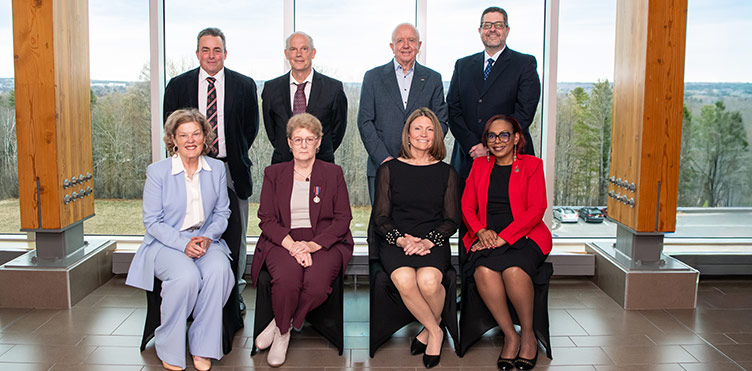
Being named a recipient of the Proudly UNB Alumni Award of Distinction, he says, is both meaningful and humbling.
“It’s a tremendous honour and I accept it with a lot of gratitude and a lot of humility. UNB is a very special place to me,” he reflects. “As a student, it shaped me and had a profound impact on me. The learning environment, the instruction, and the support I received are all ingredients that I think have set me up for whatever success I may have had so far in my career.”
But the recognition, he suggests, is less about individual achievement than about connection—to an institution, to a profession, and to a broader idea of service.
“It’s a reminder of the good fortune I’ve had,” he says. “And the opportunity to give back, even in a small way.”