
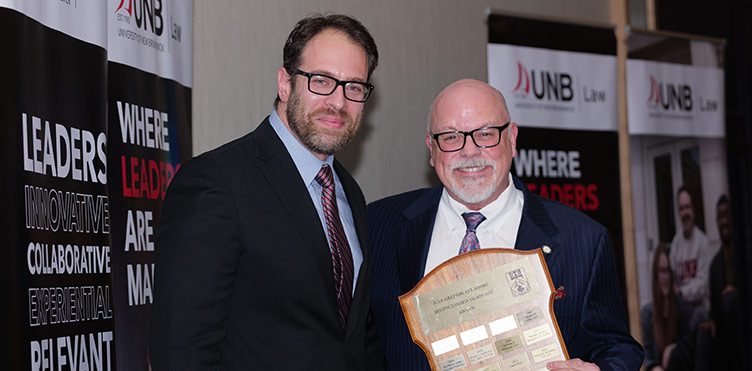
There are lawyers whose influence is measured in courtrooms and boardrooms—and then there are those whose impact quietly extends far beyond them. For Marc Mercier (LLB’91), the 2026 recipient of the Ilsa Greenblatt Shore Distinguished Graduate Award, the measure of a career is found not only in the complexity of the transactions he has led, but in the lives, institutions, and communities he has helped shape along the way.
This year’s honour recognizes a rare duality: an exceptional legal career at the highest levels of Canadian practice, and a sustained, deeply rooted personal commitment to the advancement of youth through amateur hockey—where young athletes learn lessons in discipline, teamwork, and accountability that extend far beyond the game.
Mercier reflects on the recognition not simply as a personal milestone, but as an opportunity to reflect on the institution that helped shape his understanding of the profession—and his values.
“My time at UNB Law was formative in a myriad of ways that have endured well beyond the classroom. The school instilled a rigorous respect for the law as a profession of public trust, but it also imparted something more durable: a sense that excellence in legal practice is inseparable from judgment, service, and engagement with the communities we serve. Those values were cultivated daily—through faculty mentorship, collegial expectations, and the shared understanding that how one practises matters just as much as what one achieves.”

At Cassels, one of Canada’s leading business law firms, Mercier has built a formidable reputation as a senior partner in the Banking & Specialty Finance Group, developing a sophisticated practice spanning corporate finance, mergers and acquisitions, treasury management, complex restructurings, and most recently family enterprise and private client advisory work. Over more than three decades, Mercier has become a trusted advisor to numerous financial institutions, corporate clients, and clients within the private client and family enterprise ecosystem—domestic and foreign alike—navigating periods of both growth and uncertainty.
His representative work reads like a map of Canada’s corporate and financial landscape, which has included his key work for the Government of Canada in connection with the restructurings of General Motors and Chrysler. He has also advised large, institutional clients, such as Bank of Montreal, the Business Development Bank of Canada and Harley-Davidson throughout his career and has supported as lead counsel numerous private companies in the energy, technology and manufacturing sectors.
“What has always appealed to me about banking and finance law in particular is that it sits at the intersection of legal analysis, business judgment, human relationships and business activity in Canada and internationally. Some of the most significant files I have worked on involved moments of real consequence for clients, industries, and communities. I have been fortunate to participate in transactions and restructurings that required not only technical precision, but high levels of collaboration, resilience, and trust among many people working toward a common objective.”
His work in banking and finance has earned consistent recognition from leading national and international directories, including Best Lawyers in Canada, Chambers Canada, Chambers Global, Legal 500 Canada, Lexology Index: Canada, and Martindale-Hubbell (Distinguished™ Rating). Yet for Mercier, the work is not defined by headline figures and accolades alone, but by the responsibility that comes with them.
In addition to his active transactional practice, Mercier served as a member and Past Chair of Cassels’ Audit & Risk Management Committee and he has held several of the firm’s most significant leadership roles, including Chair of the Professional Development Committee, Chair of the Financial Services Group and as an Executive Committee member of the firm. Colleagues point to his steady presence as a mentor—someone who not only advances the practice of law but actively invests in those working closely with him and in particular younger lawyers coming up through the ranks.
“Mentorship has always been one of the most rewarding aspects of my career,” Mercier explains. “The legal profession is built on the passing down of knowledge, judgment, and professional values from one generation to the next. I benefited greatly from generous mentors early in my career, and I have always felt a responsibility to provide the same support and encouragement to younger lawyers as they develop their own practices and professional identities.”
For Mercier, one of the enduring strengths of the legal profession is its capacity to create lasting communities of mentorship, professionalism, and public service.
“Throughout my career, I have tried to contribute in a way that reflects those values, whether through private practice, teaching, or community involvement. To receive this recognition from UNB is both humbling and deeply meaningful.”
That same commitment to development extends beyond the firm. Mercier has long been engaged in legal education, having taught advanced financing law at both the University of Toronto Faculty of Law and Osgoode Hall Law School, where he contributed to graduate-level banking and finance programs for more than a decade. He is also widely published in the field, with works spanning secured lending, derivatives, banking law, and restructuring, including contributions to Halsbury’s Laws of Canada and The Law of Banking and Payment in Canada. In addition, given his commitment to modernizing and harmonizing global business rules and facilitating international trade and investment, Mercier has also worked on special projects for the Law Commission of Canada to help address secured financing challenges for intellectual property assets and even worked at the headquarters of the Vienna International Centre, the United Nations Commission on International Trade Law (UNCITRAL) in the field of international trade law.

But it is outside the world of corporate finance where Mercier’s leadership takes on a different dimension—one rooted in over two decades of commitment to junior and senior hockey and helping shape the culture and character of the sport across his home province of Ontario.
“Beyond his outstanding accomplishments in the legal profession, Marc has shown extraordinary leadership and service in youth hockey,” says Dean Marin. “He has played a transformative role in fostering player development, promoting safety, integrity and professionalism in sport, and helping shape hockey as a positive developmental experience for countless young people. His service in this area is a powerful example of how legal professionals can leverage their leadership skills to make meaningful contributions well beyond the practice of law.”
As Chair of the Ontario Hockey Association (OHA) and a long-serving leader within the Ontario Junior Hockey League (OJHL), Mercier has helped guide the governance, integrity, and development of the sport at a critical time across the entire ecosystem of the game.
Mercier was nominated for the award by fellow UNB grad, Murray Nystrom (BPE’92), who shared the following words of praise for his colleague and friend: “I have had the opportunity, over the past three years, to work alongside Mr. Mercier in my role with the OHA. During that time, I have observed a high level of commitment, professionalism and stewardship, as he serves the OHA as Chair and helps grow the game in central Canada. Mr. Mercier’s commitment to enhancing the player’s and family’s junior hockey experience is highlighted with his prioritization of matters related to player safety, their interactions within communities, and the promotion of diversity and inclusivity within the many member organizations that make up the broad OHA geographical footprint.”
Underlying Mercier’s commitment to amateur hockey is a deep belief in the power of sport to build confidence, instill discipline, and teach young people the value of teamwork and perseverance. When asked about this, Mercier said “One of the great strengths of sport, and hockey in particular, is its ability to shape character, resilience, responsibility, and a sense of belonging at an early stage in life. The game teaches young people how to work together, how to lead responsibly, how to respond to adversity, and how to respect others. Equally important, the future of hockey depends on ensuring that the game is safe, inclusive, and welcoming to every participant, regardless of background or circumstance. When sport is at its best, it becomes far more than competition—it becomes a vehicle for personal growth, community building, and lifelong connection.”
Mercier’s impact has been formally recognized within the sport itself. In 2018, the Ontario Junior Hockey League awarded Mercier its Chairman’s Award in recognition of his leadership and dedication to the league’s values. In a rare and lasting tribute, the honour was later renamed the “Marc Mercier Chairman’s Award,” cementing his influence within the organization not as symbolic, but structural, woven into the league’s ongoing identity.
Earlier this June, Mercier was named the 2025-26 recipient of the Ontario Hockey Association’s Golden Stick Award, the OHA’s highest honour. The award recognizes individuals who have demonstrated outstanding and sustained service to the game of hockey for at least 10 years in a non-playing capacity.
“Marc embodies the OHA motto of growing individuals and communities through hockey,” said Mark Tuck, OHA Executive Director. “His unrelenting commitment ensures that Ontarians have a safe, competitive, and positive hockey experience.”

Mercier was presented with the Greenblatt Shore Award at the 2026 UNB Law graduation dinner this past May. Speaking to an audience of graduates and their families, he reflected on the importance of human connection, community, and a commitment to giving back.
He began by emphasizing that the practice of law is fundamentally relational, a people profession: “It is very easy—especially early in your career—to live behind your computer screen. To communicate through emails. To refine and rework the perfect written response. But some of the most important parts of this profession don’t happen that way. They happen in conversations. They happen when you walk down the hall, pick up the phone, or sit down with someone and talk something through.”
He continued, underscoring how those everyday interactions shape both trust and professional judgment: “That’s where trust is built. That’s where opportunities begin. And that’s where you develop judgment—not just technical skill. If there’s one small piece of advice I would offer, it’s this: Don’t underestimate the value of being present—with your time, your attention, and your curiosity.”
Turning to life beyond the profession, Mercier spoke about the grounding influence of community involvement, sharing, “Some of the most rewarding experiences I’ve had have come outside of work—through sports, through community involvement, and simply through showing up where I was needed. It doesn’t have to be complicated. It doesn’t have to take a great deal of time. But being connected to a community—whatever that looks like for you—keeps you grounded. It broadens your perspective. And it reminds you that the work we do ultimately connects back to people.”
He closed with a message to graduating students about perspective, curiosity, and contribution: “You are leaving here with a strong foundation. You are well prepared—whether you fully realize it yet or not. As you move forward, I hope you stay curious. I hope you stay connected to people. And I hope you remain grounded in something beyond the day-to-day demands of your work. If you can do that—the rest tends to follow. And I’ll leave you with this final thought: Your career will be shaped not just by how well you work—but by how well you think, how well you connect, and what you choose to contribute beyond yourself.”
UNB Law is honoured to recognize Marc Mercier, whose career reflects the way professional excellence and personal commitment reinforce one another. The Ilsa Greenblatt Shore Distinguished Graduate Award honours alumni whose leadership extends beyond their profession, and Mercier embodies that principle. Whether in law or through his life-long connection to hockey, his work is grounded in mentorship, discipline, and opportunity—guided by a belief that lasting systems are built with care, trust, and purpose.