
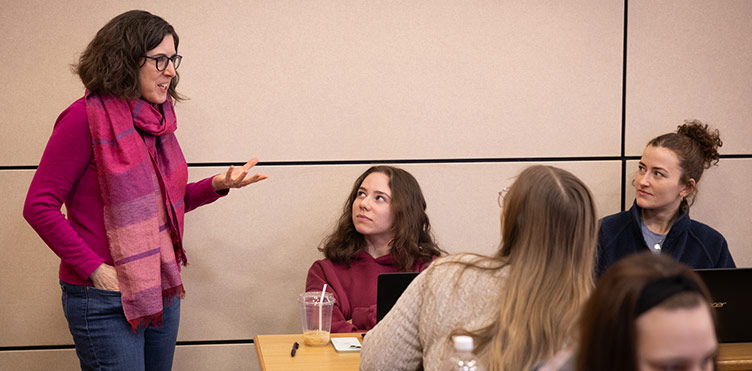
Long before students master torts, remedies, or legal reasoning, they learn an important lesson in Professor Hilary Young’s classroom: the law demands careful thought, intellectual curiosity, and a willingness to grapple with difficult questions. Prof. Young has built a reputation for challenging students to push beyond easy answers while providing the support they need to succeed. Her classes are rigorous and demanding, but equally defined by an unwavering commitment to student success.
That balance—high expectations paired with genuine support—has earned Prof. Young this year’s Teaching Excellence Award, a recognition that reflects not only her skill in the classroom, but also the lasting impact she has had on the UNB Law community.
“I am honoured to be recognized for my teaching, especially given how many excellent educators we have at UNB Law,” says Prof. Young. “Teaching is one of the hardest, but most rewarding things we do, and nothing else we do has as much impact. I am privileged to get to teach students who bring their intelligence, humanity and curiosity to the classroom. They are what makes teaching so much fun.”
For Prof. Young, great teaching begins with a simple principle: challenge students intellectually while ensuring they are supported every step of the way.
“The teachers I have admired most are those who raise the bar, rather than teaching to the lowest common denominator, while doing their best to ensure no one is left behind,” she says.
It is a philosophy visible across every aspect of her teaching. Whether in first-year Torts, upper-year Remedies, or specialized seminars on subjects ranging from privacy to health law, Young approaches legal education not as rote instruction, but as an invitation into a larger conversation about law, society, and justice.
“Law is not a mere set of discoverable rules,” she explains. “Rather, law reflects an ongoing conversation between the public, legislators and the judiciary about the state’s role in our lives.”
That perspective shapes the atmosphere she works to cultivate in the classroom: one grounded in mutual respect, intellectual curiosity, and open discussion. Students are encouraged to participate, debate policy questions, test ideas, and critically evaluate legal principles. Prof. Young combines lectures with hypotheticals, collaborative exercises, policy discussions, and practical problem-solving, recognizing that students learn in different ways and benefit from different teaching methods.
Prof. Young invests significant time in supporting students individually. She regularly meets with students for extended one-on-one conversations outside class, ensuring they have opportunities to ask questions, work through difficult concepts, and build confidence in their abilities.
Her approach is perhaps most visible in Torts, where she places a strong emphasis on developing common law methodology and legal reasoning skills. Rather than relying on a single high-stakes final exam, Prof. Young incorporates continuous assessment, detailed written feedback, and extensive practical exercises designed to help students learn how lawyers actually think.
“We do dozens of problems in Torts,” she says, “from 10-minute in-class ones to assignments worth 60 per cent of the term grade.”
One of the hallmarks of Young’s teaching is her willingness to continually adapt and refine her courses. Over the years, she has introduced pre-recorded mini lectures to reinforce foundational concepts, developed reading prompts to focus class discussions, and redesigned assignments to provide students with more individualized feedback.
She is also intentional about building confidence early. For several years, Young has opened her first Torts class not with a syllabus review, but with a problem/discussion centered on the Harvest Music Festival. Students, despite having no formal legal training yet, are asked to identify issues of wrongdoing, causation, and remedy.
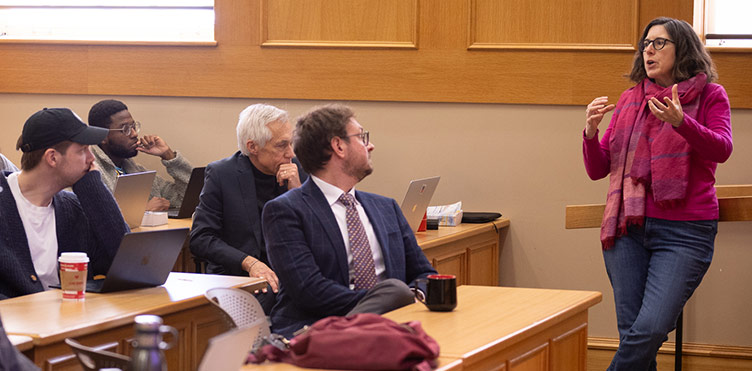
“The purpose is to engage and interest students from the outset,” she explains, “and to get them thinking about some of the major issues.”
The exercise has become memorable for many students, offering an immediate reminder that the law is not abstract or distant, but deeply connected to real human experiences.
That same commitment to relevance and engagement extends beyond the classroom. In her Health Law course, Young incorporates material connected to the Truth and Reconciliation Commission’s Calls to Action.
“We read about health disparities between indigenous and non-indigenous Canadians,” she explains. “We explore systemic racism in the provision of health care, and study legal disputes between the federal and provincial government over funding indigenous health and Jordan’s Principle, focusing on the ways indigenous people have suffered as a result of division of powers struggles.”
She has also created opportunities for students to contribute directly to real-world legal reform work. While collaborating on a defamation law reform project with the Law Commission of Ontario, Young involved students in researching how young people understand online reputation and social media use. Their work ultimately informed materials connected to the commission’s final report.
While students know Prof. Young as a dedicated and innovative teacher, her colleagues know her as one of the driving forces behind teaching and learning at UNB Law.
“Within the faculty, I can think of no other colleague who has done more to advance teaching and learning,” shares Professor Nicole O'Byrne.
Over the years, Young has helped shape the faculty's academic life through an extraordinary record of service. She has chaired the Curriculum Committee, led the Teaching and Research Committee, organized countless Works in Progress sessions to support faculty scholarship, and served on both the Student Standing and Promotions Committee and the UNB Senate. In each role, she has worked to strengthen the educational experience not only for her own students, but for the entire law school and the broader university community.
“As a newer member of the faculty, I have particularly appreciated Prof. Young’s initiative in organizing meetings and workshops dedicated to teaching and pedagogy,” says Bruno Gélinas-Faucher. “These efforts foster a collaborative environment around teaching practices and reflect strong educational leadership within the faculty.”
The same intellectual curiosity and commitment to excellence that define Prof. Young's teaching are also evident in her scholarship. Prof. Young's research work spans tort law, defamation law, anti-SLAPP legislation, media law, online harms, remedies, informed consent, and medical assistance in dying—fields that engage some of the most complex and evolving legal questions in Canadian society.
In 2024, Young was named a University Research Scholar at the President's Awards in recognition of her exceptional scholarship and internationally acclaimed research in the areas of defamation, tort, and health law.
In his nomination letter, Professor John Kleefeld wrote, “Hilary is an incredible asset to our law school. Her research is cited by courts nationwide, influencing legislation and making a tangible impact. She is a valuable mentor to junior colleagues in the faculty and is a fine example of teaching excellence combined with research prowess.”
The observation captures what makes Young's contribution to UNB Law so remarkable. Whether in the classroom, through her scholarship, or in service to the faculty and University, she approaches her work with the same commitment to excellence, curiosity, and generosity.
For the students who have sat in her classroom, and the colleagues who have learned alongside her, that commitment has made a lasting impression.
This year's Teaching Excellence Award recognizes not only an exceptional teacher, but a scholar, mentor, and leader whose influence can be felt throughout UNB Law. It is a fitting tribute to an educator who has spent her career helping others reach higher.