
By Mackenzie W.G. Oxley
What does a quiet forest trail in New Brunswick have to do with the laws of war? For students at UNB Law, the answer came during a unique seminar that bridges classroom theory with practice.
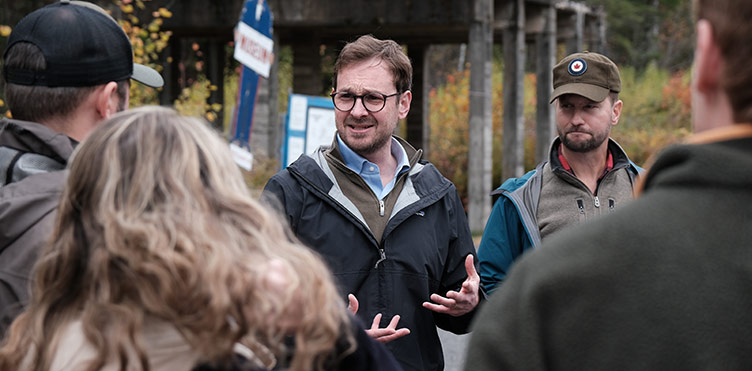
On October 17, 2025, upper-year students in Dr. David Matyas’ International Humanitarian Law (IHL) seminar, along with undergraduate and graduate students in the Department of Historical Studies, stepped out of the classroom and into history. A full-day program in partnership with Dr. Cindy Brown and Dr. Lee Windsor at UNB’s Gregg Centre for the Study of War and Society culminated at Internment Camp B/70 near Minto, New Brunswick—a site that once held “enemy aliens” during the Second World War. Today, hearing those words, “enemy aliens,” feels unnerving. The study of law is at times abstract, and often covers uncomfortable topics. Yet that law is more approachable when we contextualize its theory through lived history. The law becomes real.
This is especially relevant for the teaching of IHL because the conflicts of the world can feel far from our place of learning. The seminar and excursion remind us that international conflict is part of the Atlantic Canadian story, and that studying international law remains pressing and substantial work close to everyone.
“The International Humanitarian Law seminar aims to immerse students in an area of law as challenging as it is salient. While students come into the course with a sense of why sources of IHL—like the Geneva Conventions—are important, the seminar makes space to consider the intricacies, tensions, and critiques of this regime. More specifically, it works to showcase why IHL is not only relevant internationally, but also of critical important to Atlantic Canada.”
International Humanitarian Law (also called the “Law of Armed Conflict”) guides how wars are fought, and how civilians or detainees ought to be classified and treated during armed conflict. For many students, this seminar was their first deep dive into the subject. For some, it was their first dive into public international law generally. Nonetheless, Dr. Matyas designed the course to move beyond textbooks, grounding complex legal principles through lived experience. Simulations in the classroom approached fact scenarios through contextualized, legal strategy.
The seminar informed students of legal doctrine, preparing them for practice, while emphasizing the real impact that the field of IHL has on people around the world. Again, the seminar’s simulations were based on real-life armed conflicts. The students were well equipped to approach the subject matter with care and precision. The course lectures and readings provided the scholarly foundation, and allowed students to flourish academically by pursuing IHL topics they were passionate about. Closer to home, the seminar also connected IHL to New Brunswick and Atlantic Canada.
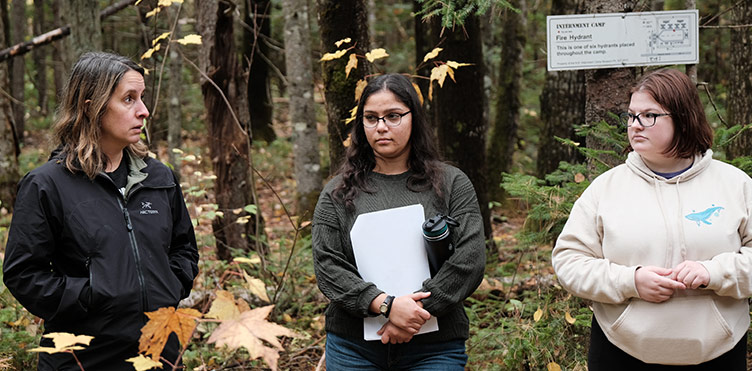
At the forefront of this connection between IHL and New Brunswick was the full-day program on the laws of detention and internment, complete with an excursion to Internment Camp B/70. In class, we had read about how IHL guides the classification and treatment of civilians and combatants detained during armed conflict. Now we had the chance to explore the application of these laws in our own backyard.
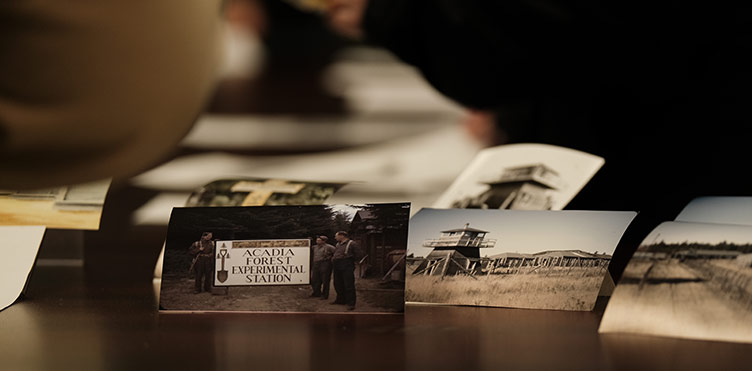
To better understand why these camps were established, IHL students explored archival materials and stories from Internment Camp B/70 that brought the law governing this camp to fruition. These archival materials were collected, and presented by members of the UNB’s Gregg Centre for the Study of War. Dr. Cindy Brown, Executive Director, and Dr. Lee Windsor contextualized the photographs and historical insights of the people in the internment camps.
Dr. Brown reflected on the experience, stating, “The opportunity to connect our students, who study these episodes in the past, with Law students who are learning about the application of international humanitarian law in the present at an important site in New Brunswick’s past is a powerful way and interdisciplinary way to think about continuity and change and the gap between practice and reality. We look forward to future collaborative opportunities with Dr. Matyas and his students.”
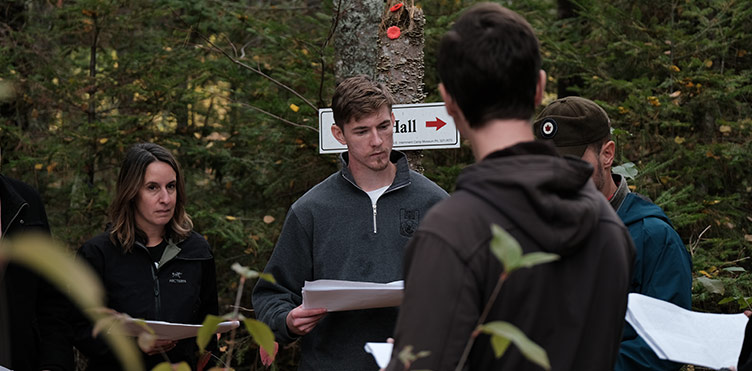
One story stood out: Henry Kreisel, a 17-year-old Austrian refugee, who was interned at Camp B/70 in 1940 after being classified as an “enemy alien” in England. Kreisel had written his experience travelling to and living in Camp B/70. When students arrived at the site of Camp B/70 near Minto, we stood before the trees where the buildings once were, reading aloud Kreisel’s words as if they were written yesterday.
Kreisel’s experience offered a poignant reminder of how global conflict reached into rural New Brunswick. Kreisel described Canada as “a silent, mysterious land” whose doors were tightly shut to refugees. He would be released after the war, and go on to earn a Ph.D. and became Vice-President Academic at the University of Alberta — a testament to resilience amid hardship. Without the living history provided by Kreisel, originating 85 years in the past, we would not know how close to home history and IHL plays.
For today’s law students, these lessons are more than historical footnotes. Students must see the impact that the law has on the people and places near and far to us. They illustrate why regulating war matters and how international law shapes real lives. By linking theory to local history, UNB Law prepares future lawyers to think critically about justice in times of conflict. We begin to ask and be asked the questions that guide the development of law tomorrow.
Why regulate war? What is an armed conflict? To whom does this area of law apply? Should different people receive special or different treatment?
It is challenging to define an international reality without identifying the analogs or connecting students with the application of the questions above. Camp B/70 was established near Minto, New Brunswick, and it one of twenty-eight internment camps that operated between 1939 and 1947 during the Second World War.1 During this time, the international laws of detention & internment applied broadly to internment across Canada. Identifying this displays a broad “Canadian” history, yet brings to the forefront Atlantic Canada’s involvement in public international law and IHL.
When students began Dr. Matyas’ IHL course, not many would have connected the laws of armed conflict to Atlantic Canada. Bernie Morgan, a third-year student taking the IHL seminar, would reflect on his experience:
“The trip to Ripples (Camp B/70) was an eye-opening experiential learning opportunity for Law and History students at UNB’s Fredericton campus. “Internment” camps might often be conflated with the sinister concentration camps in Eastern Europe. Some may even know of the internment of Japanese populations in western North America. Few, however, would look so close to home. I, for one, did not. While history is said to be written by the victor, this exercise emphasized the need to critically think about contemporary issues in what is fast becoming a society divided.”
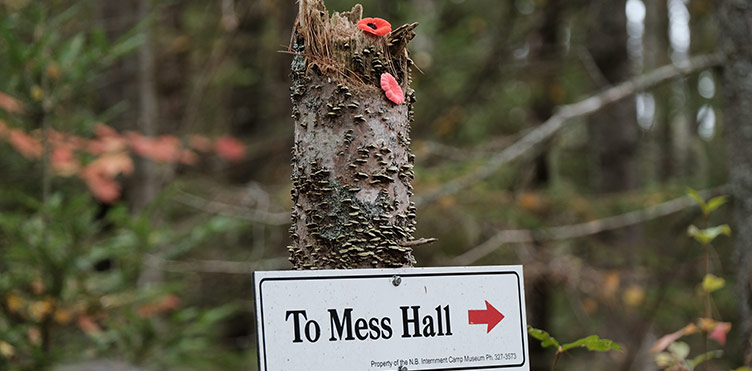
A course like International Humanitarian law broadens a global perspective while grounding students in local history. Understanding how history shapes both local and global communities is essential to the responsibility that lawyers carry in practice. Learning about IHL by visiting Camp B/70, which is now a marked, quiet trail in New Brunswick, highlights that responsibility to apply these principles thoughtfully and with care. Such reflection is made possible by those who steward the land and preserve its history.
Only when we understand history, and its effects on the local and global community, can we develop into well-rounded lawyers that affect change in our communities.