

On a Saturday morning in New Brunswick, a minor hockey game ends the way thousands do each season: a whistle, a handshake line, a few lingering disagreements at centre ice, and then a quick exit into the cold parking lot.
For most participants, it’s over.
But for some, the disagreement that began on the ice does not end when the rink lights dim. It becomes a complaint, a dispute, a question of fairness that amateur sport organizations—often run by volunteers—must somehow resolve. Increasingly, those questions are finding their way to a new kind of legal clinic at UNB Law.

The Sport Law Clinic, led by UNB Law alumnus and lawyer Kelly T. VanBuskirk, K.C., PhD, C. Arb (LLB’92), is quickly carving out a space at the intersection of sport, law, and community. It provides investigation and adjudication services to local, provincial, and national amateur sport organizations while giving law students a rare window into real-world decision-making.
It is, in VanBuskirk’s words, a place where law is not abstract.
“It’s completely administrative in nature,” he says. “And the students are working with real organizations, real disputes, and real consequences.”
The idea for the Clinic did not begin in a boardroom or a classroom. It began, fittingly, in the world of sport itself. VanBuskirk had been involved with Hockey New Brunswick’s elite hockey commission, where he saw firsthand the legal pressures facing amateur sports organizations.
“There was lots of demand for legal advice and legal service,” he says, “not only from hockey but from other sport organizations across the province.”
Those organizations, he explains, were often navigating complex issues—discipline, governance, and disputes—without the legal infrastructure to properly manage them.
“In discussions with Hockey New Brunswick’s president and executive director, I thought it would be useful to communicate with the law school,” he says. “We had a call with Dean Marin, and the idea started to take shape.”
UNB Law Dean Michael Marin, a sports enthusiast himself, was immediately interested. A series of conversations followed with Hockey New Brunswick leadership.
“It came about pretty quickly after that,” VanBuskirk says. “That’s really how the Sport Law Clinic was born.”
What emerged was a partnership that bridged the gap between legal education and community need: a clinic that would provide free investigative and adjudicative services to sport organizations, supervised by a lawyer, and powered by students.
At its core, the Sport Law Clinic exists because most amateur sport organizations cannot afford legal services.
“Many sport organizations just don’t have the financial resources to hire lawyers every time there is a conflict or legal problem,” VanBuskirk explains.
These organizations are typically volunteer run. Coaches, parents, and community members find themselves responsible for governance, discipline, and dispute resolution—often without formal legal training.
The Clinic steps into that gap. It assists with governance documents and bylaws, but its most significant work involves investigations into allegations of harassment, discrimination, and in-game misconduct.
“These are unbiased investigations and determinations,” says VanBuskirk. “And that matters, because volunteers are trying to do the right thing, but they don’t always have the resources or expertise to do it in a structured way.”
The impact, he adds, extends in both directions. For organizations, it provides structure and confidence. For athletes, it provides fairness.
“They can feel more confident that decisions about their sport or disciplinary process are being made independently,” he says. “By people who don’t have connections to their teams or communities.”
For UNB Law students, the Clinic represents something rare but important in legal education: meaningful experiential learning before graduation. The students are working with real-life clients who come to them with real problems.
Under supervision, students conduct investigations modeled on workplace procedures. They learn how to gather evidence, assess credibility, and navigate situations where witnesses may be uncooperative or inconsistent.
“It’s similar to what you would see in workplace investigations,” VanBuskirk adds. “But the learning extends beyond process. They learn deadlines. They learn pressure. They learn what it feels like when the answer isn’t immediately clear.”
And in investigation work, that uncertainty becomes personal.
“Think of, for instance, a situation where two 14-year-old athletes tell completely different accounts of the same event,” explains VanBuskirk. “The students have to try to figure out what really took place, and further, make a determination that is going to be enormously disappointing to someone. Well, that’s what lawyers, arbitrators, and judges do. And I think that’s a pretty rare opportunity for law students.”
For graduating student Kyle Kennedy, one of the most important learning outcomes was developing information-gathering skills through investigative interviews.
“We learned the importance of active listening and asking the right questions to gain more information. I feel this will serve me well in practice—as Kelly would say, the more information you can get in your funnel, the better off you are.”
Second-year student Ed Arsenault echoes the experience of his classmate, adding, “The most practical and valuable skill I gained through the Clinic was learning how to conduct investigations in a non-partisan and professional manner. Being entrusted with investigations that carried real-world consequences and approaching them objectively was an experience I would not typically get in a traditional law school setting. That is a skill that will be invaluable not only to my own career but also to any firm I work for.”
For students, that moment is formative.
“It gives them firsthand experience with the human reality of conflict,” VanBuskirk says. “That’s what lawyers, arbitrators, and judges do.”
It is also, he suggests, something that cannot be fully replicated in a classroom.
“There’s a pretty rare opportunity here,” he says. “To sit in the seat of a decision-maker and apply legal principles to real facts with real consequences.”
The Clinic is designed not only to teach law, but to teach judgment. Students work collaboratively, often confronting ambiguity and complexity in ways that mirror legal practice.
“One of the things I value most about the Clinic is how collaborative it is,” shares Arsenault. “Working closely with other students meant constantly talking through problems, testing ideas, and learning from different perspectives. Our supervisor, Kelly, provided strong guidance throughout, but a lot of my growth came from working day-to-day with my peers. Through that process, I picked up not only legal skills, but also a better sense of how to carry myself and communicate when working with clients.”
“They have to exercise creativity,” VanBuskirk says. “They have to apply their legal knowledge and work together to arrive at the best outcome.”
That includes learning how to manage uncertainty itself.
“There’s that feeling when a problem comes in and there isn’t an obvious answer,” he says. “They have to learn to sit with that.”
It is, he suggests, one of the most important skills they develop. Because in practice, law is rarely clean. You’re always balancing competing considerations. And trying to make the best decision you can with the information you have.
What began as a provincial initiative is now attracting national attention. The Clinic was recently invited to present at the Beyond Boards summit in Toronto, a major gathering in the hockey governance world.
“As a consequence of that, we’ve been contacted by more organizations across the country,” VanBuskirk says.
Interest is also growing within academia. Other law schools have begun exploring similar models, including Western Law. The expansion, VanBuskirk suggests, reflects both need and credibility.
“People can see that it’s a valuable service for sport organizations,” he says. “But also a valuable training ground for students.”
At UNB, he believes, certain academic structures make that possible in a way not all schools can replicate. For example, Administrative Law is a required course at UNB Law—an essential foundation for the Clinic’s work.
“That gives students a grounding in the kind of legal framework they’re operating in,” he says. “Sport law is essentially administrative law in practice.”
The Clinic’s work extends beyond case files. Students also complete research projects addressing broader issues in sport. One project, for example, examined why young hockey officials leave the game—an issue affecting leagues across the country. Another, by Emily Encalada, focused on the role of media in high-profile sports sexual assault cases, including the Hockey Canada sexual assault trial.
“I researched how media narratives surrounding high-profile sports sexual assault cases may influence how women experience and navigate the legal profession,” explains Encalada. “The symposium and the Sport Law Clinic provided an important opportunity to discuss how law, media, and sport intersect in shaping perceptions of justice and professional identity.”
“These are real problems in sport,” VanBuskirk says. “And the students are thinking about them from both legal and social perspectives.”
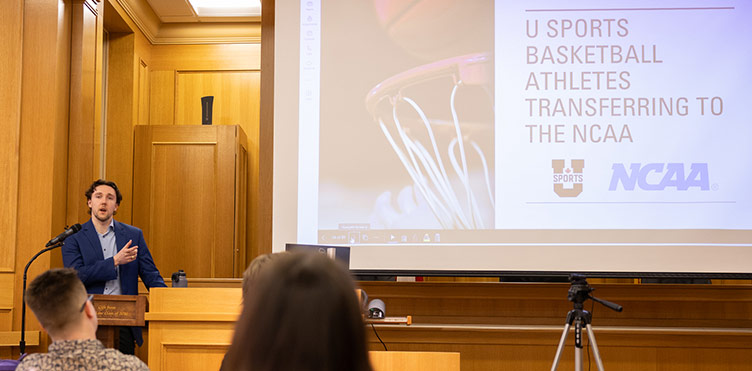
These projects are then presented to partners and community members at the annual Sport Law Symposium.
The Clinic has also fostered interdisciplinary collaboration, including connections with UNB’s Faculty of Business and sport management scholar Jonathan Edwards.
“What we’re hoping,” says VanBuskirk, “is that the work of the Clinic builds more community.”
For VanBuskirk, the Sport Law Clinic is ultimately about more than dispute resolution or legal training. It is about access.
It is about fairness in spaces that are often informal but deeply meaningful. And it is about preparing students not just to know the law, but to practice it under real pressure.
“It’s a tribute to the students,” he says. “They’re doing meaningful legal work, but also contributing to something bigger.”
That “something bigger,” he suggests, is community itself.
“Sport is supposed to bring people together,” he says. “And I think what the Clinic is doing is reinforcing that at a very grassroots level.”
In rinks, gymnasiums, and community fields across the province, disputes will continue. Decisions will still need to be made. But now, some of those decisions are shaped by a new kind of bench—one built not only on law, but on learning, fairness, and connection. And at its centre are students discovering what it means to decide when the stakes are real.