
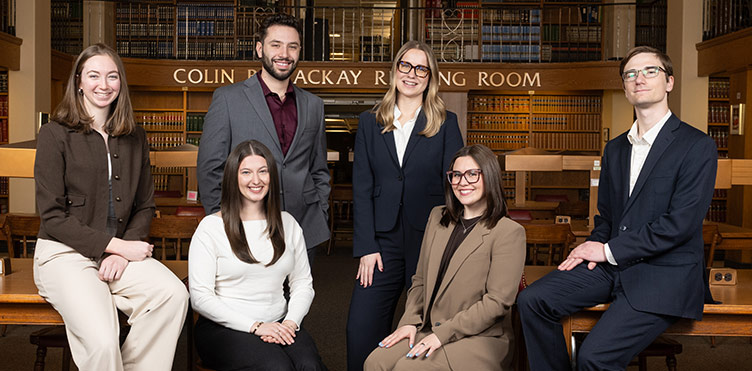
The 2027–28 clerkship class reflects UNB Law’s continued strength in preparing students for some of the country’s most competitive judicial clerkships. This spring, six students accepted clerkships at courts including the Federal Court of Appeal, the Court of Appeal for Ontario, the British Columbia Court of Appeal, the Federal Court of Canada, the New Brunswick Court of Appeal, and the Ontario Superior Court of Justice.
Randy Antle, who is entering his third year at UNB Law, is excited to bring his interest in administrative law to the Federal Court of Appeal in Ottawa, where he will clerk for the Hon. Justice David Stratas, beginning in August 2027.
Antle brings a unique perspective to law school, shaped by years spent working on the water in his hometown of Souris, Prince Edward Island.
“Souris is a small town on the eastern end of PEI. There, everything is directly tied to the water,” he says. “Before I ever considered law school, I spent many years lobster fishing and oyster farming.”
Those experiences, he explains, sparked an interest in the legal and regulatory systems shaping Atlantic Canadian industries and communities.
“I saw firsthand how administrative decisions made in Ottawa, disconnected from the fisheries, impacted those around me,” he says. “From that point on, I became fascinated by the legal frameworks that governed the daily lives of those around me, and I wanted to be involved when those regulations were interpreted and challenged.”
That curiosity ultimately led him to UNB Law, where his interest in administrative law continued to deepen through coursework, research, and a judicial internship at the New Brunswick Provincial Court.
“My goal has always been to take the work ethic I learned on the water and apply it to complex legal problems, bridging practical industry experience with high-level legal analysis,” he says. “After my internship, I realized I wanted to engage with the law at a higher level, and this clerkship feels like a meaningful next step. The opportunity to learn from some of the best legal minds in the country, while continuing to refine my research and writing skills, is incredibly exciting.”
Emily Holt, who is entering her third year at UNB Law, will clerk at the Court of Appeal for Ontario, beginning in August 2027. Holt, whose undergraduate degree is in Medical Sciences, says the study of law felt like a natural fit.
“In the end, I chose law because I thought it fit well with my tendency to analyze everything. I also respected the way lawyers write and think.”
She sees the clerkship as a continuation of the learning she has most enjoyed during law school.“My favorite part of law school is learning the reasoning behind cases, and clerking provides a unique behind-the-scenes look at the development of that reasoning. I'm most excited for the job itself, but beyond the legal work aspect of the experience, living in Toronto will be a big change for me and I’m looking forward to that.”
Last fall, Holt was awarded the Harrison Shield as the top oral advocate at the 63rd Hon. William Henry Harrison Moot Court Competition, UNB Law’s annual in-house moot.
Zoe McDougall, who is entering her third year at UNB Law, will head back to her home province to clerk at the British Columbia Court of Appeal, with her term beginning in September 2027.
McDougall says the mentorship and advising support she received at UNB Law played a key role in preparing her for the clerkship application process.
“My mentor, Dr. Young, was incredibly helpful at every stage. She took the time to talk through the process with me, offered feedback, and was very encouraging throughout.
She also credits support from the career services office and UNB Law alumni.
“I also received a lot of support from Martha in the career services office. She helped with the logistical side of the applications and was very reassuring during what can be a stressful process. I also benefited from connecting with alumni who were willing to meet before interviews and share their experiences.”
Looking ahead to the clerkship, McDougall says she is especially excited about the collaborative environment among clerks and the breadth of subject matter at the appellate level.
“I’m most excited about working closely with other clerks. It seems like a really unique environment to learn from people who are going through the same experience, and I’m looking forward to building those relationships and learning from how others approach legal problems. I’m also excited about the range of work at the Court of Appeal. It touches on so many different areas of law, which makes it a great opportunity to keep learning and see a variety of issues.”
Recent graduate Julia Evans (JD’26) will clerk at the Federal Court of Canada in 2027 for fellow UNB Law alumna, the Hon. Ann Marie McDonald (LLB’93). For Evans, who grew up in a small New Brunswick community, the opportunity represents both a continuation of her legal education and a chance to step onto a national stage.
“I was really drawn to clerking because it felt like a chance to continue learning after law school while also pushing myself outside of my comfort zone,” she says. “Coming from a small town in New Brunswick, the opportunity to work at a national court and see such a wide range of litigation was exciting to me.”
Evans says the clerkship appealed to her not only because of the Court’s broad jurisdiction, but also because of the opportunity to strengthen her advocacy skills while gaining a new perspective on the legal system.
“Part of what interested me about clerking was the chance to challenge myself and try something completely different,” she says. “I am constantly trying to improve my oral and written advocacy, and I look forward to seeing how the legal system operates from the other side and learning from the incredible advocacy that comes before the Court.”
“The breadth of the Court’s jurisdiction really enticed me,” she adds. “My legal interests are so diverse, and I thought this opportunity would open doors, allow me to expand on existing interests while also discovering new passions. I was excited by the opportunity to see all kinds of litigation and high-quality advocacy, while also gaining a new perspective on the law that you do not necessarily get in a classroom setting.”
Recent grad, Nathanial Box (JD’26), will clerk at the New Brunswick Court of Appeal beginning in June 2027.
“I chose the New Brunswick Court of Appeal in part because it is the appellate court of my home,” he says. “Its decisions matter to the people and communities in which I live. However, those decisions are seldom made easily. In matters of public law jurisprudence specifically, New Brunswick routinely ‘punches above its weight class,’ and I want to be a part of that.”
Box grew up in Lincoln, New Brunswick, and says his interest in public service has a central motivation in his career aspirations. Prior to beginning his clerkship, Box aims to complete his articles with General Counsel for the City of Saint John. He describes the clerkship as both an opportunity and a challenge to contribute in a new and meaningful way to the administration of justice.
“I am excited to have an opportunity to test my legal reasoning and refine my communication skills with a true pillar of the legal community in New Brunswick,” he says.
His path to clerking was not straightforward. Box says he was encouraged by faculty and “pressured by friends” to apply, having previously considered an application in second year but ultimately deciding he was not yet ready.
“That experience of reflection mattered,” he says. “My work with the UNB Legal Clinic in the summer of 2025 helped me identify areas of professional practice where I still want to improve during my articles.”
For Box, the clerkship is as much about learning as it is about contribution.
“I think a successful clerk should be defined as someone who contributes to decisions and decision-making,” he says. “There are guiding principles—know your audience, be concise, don’t let the perfect be the enemy of the good, and above all, cite your sources—but you also have to understand what you’re actually trying to do in the role.”
At the centre of that, he says, is curiosity and judgment.
“The most essential skill is asking questions,” he says. “Not every question needs to be asked, but knowing when to ask one is an exercise in judgment. It’s about having enough confidence to engage, but enough discretion to know when it’s necessary.”
Third-year student Lauren Whalen will clerk at the Ontario Superior Court of Justice, beginning her term in 2027.
“Receiving this clerkship feels like a natural continuation of the interests I have developed throughout law school, particularly in legal research and writing and in understanding how judges interpret the law and reach their decisions,” she says. “The opportunity to observe that process firsthand is something I am very excited about.”
Her interest in clerking, she explains, developed directly through her experiences with legal research and writing during law school. As a research assistant, she spent significant time working with complex legal materials and translating them into clear, structured analysis—work that deepened her interest in how judicial decisions are formed.
“I was especially drawn to the Ontario Superior Court of Justice because of the breadth of its jurisdiction across civil, criminal, and family law,” she says. “It offers exposure to a wide range of legal issues at the trial level.”
Whalen encourages students interested in clerkships to focus early on developing strong legal research and writing skills.
“A writing sample is an important part of the clerkship application process, so becoming a clear and effective legal writer is essential,” she says. “I would also recommend getting involved in the opportunities available through your law school, whether through research positions, clinics, volunteer work, or student organizations. Those experiences help develop practical skills while also allowing students to explore their interests and build connections within the legal community.”
She says she is most excited for the chance to engage closely with legal questions and observe how judges work through complex issues before reaching decisions.
“I’m also looking forward to being part of an environment where I can discuss legal issues with others who share a strong interest in the law,” she says. “Those conversations and perspectives will be an especially valuable part of the experience.”
Please join us in congratulating all of the students on this impressive career milestone and in wishing the best of luck to the 2026–27 clerkship class, who will begin their work terms this summer.