
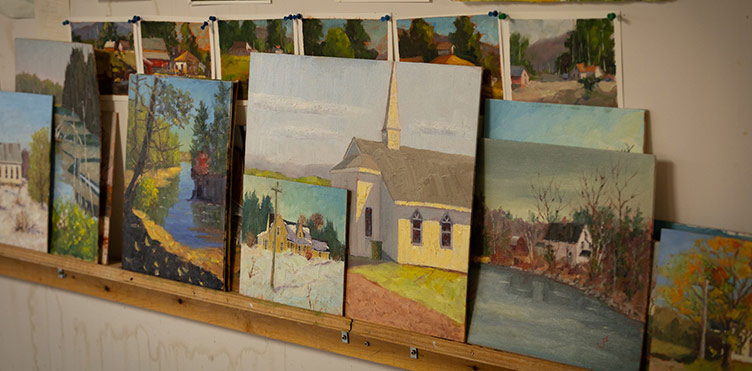
For Professor Geoff Bladon, the connection between law and painting is straight ahead: “Preparation, preparation, preparation,” he says.
It is a mindset that shaped his years in courtrooms, classrooms, and arbitration hearings—and one that carries into his work on canvas, where attention, discipline, and seeing remain central.
Now retired from a long career as a professor at the Faculty of Law, Prof. Bladon spends much of his time in his studio, thinking less about precedent and procedure and more about light, landscape, and composition. But the habits of law never fully leave him. Neither, it turns out, does the curiosity that first led him into art.
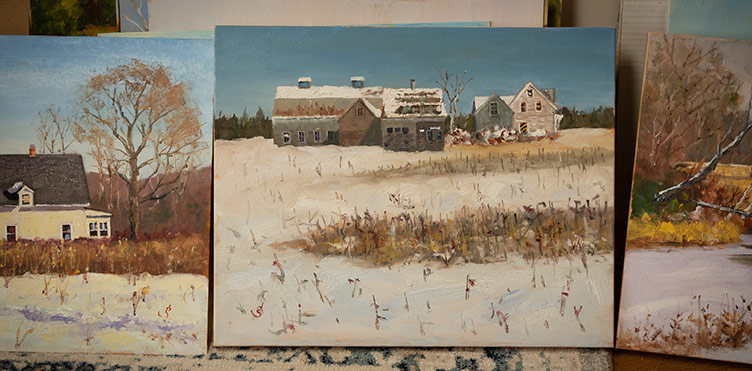
Prof. Bladon was born in South Porcupine, Ontario—part of what is now Timmins—where his father worked as a mining engineer. He spent much of his childhood in Montreal, when his father took a teaching position at McGill. Many summers were spent with family in Kennebunk, Maine—a place that left a lasting impression and would later draw him back to coastal landscapes and a life shared between the eastern United States and New Brunswick.
His first real spark of artistic interest came not in a studio, but through Classics Illustrated, an American comic book and magazine series featuring adaptations of literary classics.
“They weren’t Superman,” he recalls. “It was relatively serious stuff. I remember reading a comic on Michelangelo—that was likely the beginning. I was always drawing, and my father—because I was interested in painting—built me an easel. I can remember now the first painting I ever did was just a tree in the forest.”
That early encouragement, however, came with limits. As his father said, “Don’t think you’re going to grow up and be an artist. You’re not.”
“The old cliché,” recalls Bladon. “I got that same speech from my father; the same one as did Pissarro and Degas.”
The message was not uncommon: support for creativity, but only as long as it remained peripheral.
“So that’s why I went into law,” he says, “and I’m glad I did. I’m very grateful for the legal education I got at Queen’s University and the Law Society of Upper Canada.”
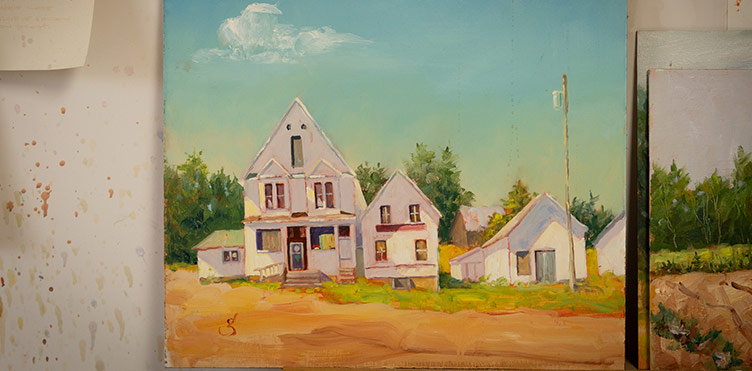
After studying at Queen’s, Prof. Bladon began practising litigation in Ontario, spending fifteen years in the rhythms of courtroom life. Then, unexpectedly, a different kind of call arrived—from Canada’s last frontier.
“I saw an ad in the Ontario Reports for a judge in the Yukon,” he says. “I thought, ‘I’ll apply for the job. I’ll probably never get it,’ but it would be interesting and a real adventure.’”
He got the position and moved north in early 1982 to become a trial judge in the Yukon Territorial Court, based in Whitehorse. The work was varied and intense.
“We had criminal jurisdiction, and that’s what we did most of, but we also had a family law jurisdiction and a small claims jurisdiction—a very compact court. The Yukon’s very different from London, Ontario. It was stimulating and the inhabitants were welcoming.”
He recalls flying in small, six-seater aircraft between communities, travelling widely across the territory, and living immersed in the rugged northern landscape.
“We had a house on the edge of the Whitehorse, with the forest behind it and a salmon run beside it.”
It was demanding work, but also formative, instilling the discipline and preparation that would later define both his teaching and his approach to painting.
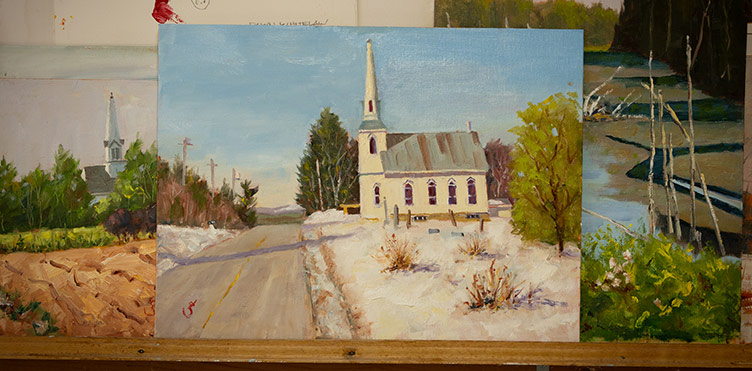
But the east beckoned—New Brunswick and its proximity to his beloved state of Maine. He resigned his then position as Chief Judge of the Yukon Territorial Court. He arrived at the University of New Brunswick Faculty of Law after earlier teaching and training at the University of Western Ontario and with the Law Society of Upper Canada.
At UNB he taught Civil Procedure, Evidence, and Trial Practice from 1987 until his retirement in 2005. What he remembers most is not doctrine, but translation—bridging the gap between theory and practice.
“What I wanted—what was in the back of my mind all the time—was that I’ve got to make the students move from the classroom to the street,” he says. “It’s not just book learning; they have to apply what they learn.”
He pushed students to see law not as fixed tradition, but as something adaptable. His advice—or calling card—was simple but firm: “You’re not chained by history. Don’t be afraid to try something different and novel, providing you know the legal history of the issue, and see how that works out. If you do your preparation, you can be successful.”
He also spent considerable time encouraging students to see themselves as competitive nationally and never as limited or an afterthought.
“At the time, students from UNB thought they were second-rate compared to students in Toronto or Vancouver,” he shares. “I tried to get that out of their heads. I said, ‘You might love being at home in PEI, but go to Toronto for three or four years, then go back when you really know what you’re doing.’”
One of his most enduring contributions was running (and coaching) the mooting program. He remembers students like the Hon. Dominic LeBlanc (LLB’92), now a senior federal cabinet minister, who he notes was “an excellent mooter.”
Still, even with strong teams and strong performances, he admits one lingering frustration. “I must say,” he adds with a smile, “I feel disappointed that we never could win the criminal moot, which I coached specifically.”
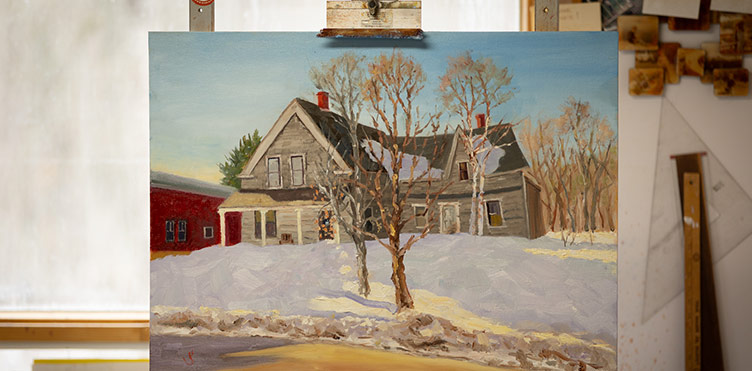
Through all of this—law practice, his time on the bench, teaching, arbitration and serving the University as the Coordinator of Fine Arts through the ‘90s—painting remained a passion, but a secondary one. Only after retiring from teaching and stepping away from labour arbitration work in 2023 did it take on a more central role.
“Now is the time,” he says. “And I want to use it. I don’t want to waste it.”
If law shaped Prof. Bladon’s discipline, his time in Maine shaped his eye.
A 27-year property owner in Tenants Harbor, a small town on the southeastern coast of Maine known for its fishing villages, lighthouses, and rugged shoreline, he spent years working and painting along the mid-coast landscape—following the footsteps of artists such as Andrew Wyeth.
“The scenery in that part of mid-coast Maine—the Port Clyde area, which is a significant draw for tourists—is special. The light, rocks, scenery, and the old New England architecture.”
His process is structured and urgent. He makes a rough sketch, then photographs the scene, and tries to begin painting in his studio within eight days. “If it’s more than that, I’m in trouble,” he says.
His style, he shares, has not fundamentally changed in decades. He describes it through a phrase borrowed from a workshop instructor, as “contemporary impressionism.”
“It means feel free to use your imagination so that when you’re painting, you’re not locked into what’s in front of you,” he explains. “That’s the stimulus for the painting, but if you want to move a tree or paint it a different colour, you’re free to do it.”
Since selling his home in Maine, his focus has shifted to the landscapes of New Brunswick near his home on Keswick Ridge and surrounding communities—from Stanley to Saint John and beyond—wherever the light creates form and contrast across the land.
“The light is really the most important part of it,” he says. “If I can paint something and you look at it and feel or see the light, that makes sense to me.”
His aim is not replication, but sensation—the time of day, the temperature, the colour of the shapes.
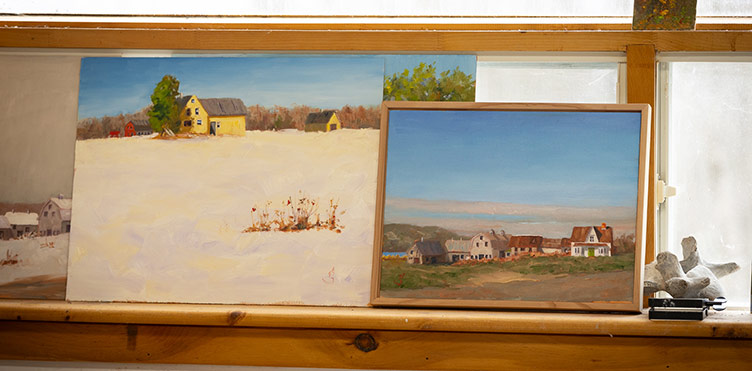
For Prof. Bladon, painting and law are not opposites but reflections of the same principles: preparation, attention to detail, and the discipline of seeing clearly before acting.
“You’ve got to think everything through before you start mucking about on the canvas.”
Even materials matter: “You’ve got to have the right brushes, paints, turpentine, canvas, easel, and mosquito repellant. You’ve got to be able to set up.”
He offers a piece of advice that extends well beyond painting: “Say you go to Stanley or Saint John or somewhere to paint and you see something and say, ‘Oh boy, that’s what I want to do.’ But you know what you should do? Turn around 180 degrees and look the other way, because that might even be better—or something you missed.”
He draws a direct parallel to courtroom practice. “I used to preach this to the students in Trial Practice all the time. If you aren’t ready and don’t know what’s going on in this case in detail, then you shouldn’t be doing it.”
Prof. Bladon is primarily self-taught, though he has furthered his understanding of the craft through workshops with artists including Christopher Schink, Judi Betts, Connie Hayes, and Colin Page.
He remains active in juried art competitions created by, for example, the Federation of Canadian Artists and the Oil Painters of America. His work has been juried into shows in Maine, including River Arts in Damariscotta and the annual Art in Maine exhibition in Boothbay.
“Acceptance into a show by a jury of experienced painters,” he says, “carries meaning as It validates what you’re spending your time on.”
He has received awards for his work in Haines, Alaska; Whitehorse, Yukon; and Rockland, Maine.
Closer to home, he contributes paintings to Isaac’s Way in Fredericton, a restaurant that auctions the artwork and divides the proceeds between the painter and arts education opportunities for children.
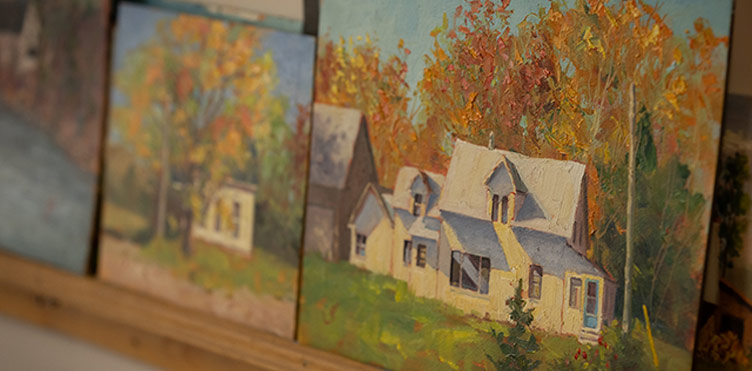
Today, Prof. Bladon paints in a studio that was once a garage. A large picture window opens onto the wilderness behind his home, drawing in a wash of natural light that falls directly across the canvas.
He renovated the space himself, adding light and structure to support his work. The transformation mirrors his own transition—practical, deliberate, and shaped by use rather than ornament.
When he begins a painting, he describes a familiar sensation. “I get a rush just sitting down and starting to put paint on the brush and then on the canvas.”
Classical music often plays in the background, but the focus is elsewhere.
It is not escape from his past life, but continuation of it—discipline refined into attention, attention refined into artistic expression.
The work continues—quietly, deliberately—one brushstroke at a time.