
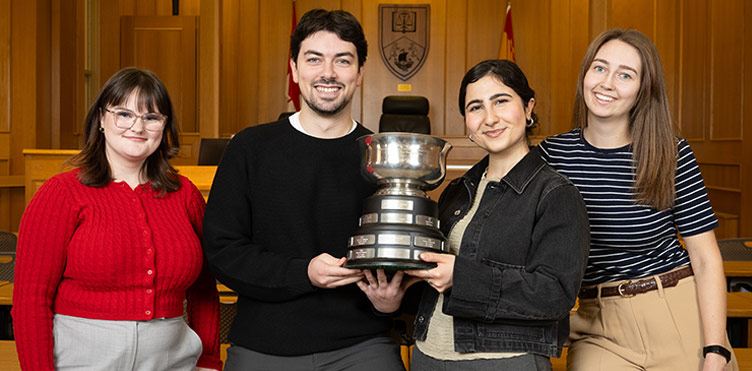
For a quarter-century, the McKelvey Cup has showcased Atlantic Canada’s strongest emerging trial advocates. This year, the competition belonged to UNB Law. In a commanding performance, Rand Al-Shujairi and Jacob Greenbaum captured first place overall, while Emily Saulnier-Eagles and Hannah Bing secured an impressive second-place finish.
Individual honours underscored the depth of the team’s success, with UNB Law sweeping nearly every major individual award. Al-Shujairi received the James Lockyer Award for Best Overall Advocate and the award for Best Cross-Examination, Greenbaum earned Best Closing Argument, and Bing was recognized for Best Direct Examination.
“It was more than a successful weekend,” says coach and mooting program coordinator, Prof. Jane Thomson. “It was the culmination of months of intensive preparation and many late nights. The results reflect not only individual talent, but the collective effort behind one of the strongest showings in the competition’s history.”
For Rand Al-Shujairi, the weekend carried a significance that stretched far beyond the competition itself—one deeply connected to the journey that brought her to Canada and ultimately UNB Law.
Al-Shujairi immigrated to Canada from Iraq with her family in 2013 at the age of 11. When she entered elementary school in Ontario for the first time, she spoke almost no English.
“I came to school on my first day knowing only a few words,” she recalls. “I was completely unaccustomed to the language and the school system.”
She was enrolled in ESL classes while simultaneously learning French, navigating not only a new country but an entirely new linguistic and cultural environment. But even in those early years, she says she was determined to learn.
“Every day I felt a little closer to being able to express myself and my thoughts,” she says.
Over time, that determination evolved into a love of language itself. Al-Shujairi eventually pursued a double major in English literature and political science before choosing law school—a path she describes as a natural fit for someone drawn to storytelling, language, and performance.
“To me, the law felt like an art form,” she says. “Words became the paintbrush.”
Today, Al-Shujairi finds it surreal to have earned top advocacy honours in a language she once struggled to speak.
“Prior to coming to Canada, most of my English came from watching movies like Harry Potter,” she recalls. “I remember sitting on the flight to Canada beside someone who spoke English and wanting so badly to try speaking to them. Now I’m studying law in English, advocating in English, and winning awards speaking a language I once struggled to understand.”
“It feels like freedom,” she says. “I can express myself in a way I couldn’t years ago, and use that ability to help other people and advocate for justice.”
For Jacob Greenbaum, who earned the award for Best Closing and, alongside Rand Al-Shujairi, captured first place, the recognition felt like the culmination of nearly a year of work.
“It was incredible to see our hard work pay off,” he says. “We had been developing these skills since the beginning of the school year, so hearing our names called as the top overall team was one of the proudest moments of my academic career.”
Greenbaum says his closing statement became an obsession in the weeks leading up to the competition.
“I checked my folder and saw that my final version was called ‘Closing Draft 17,’” he says with a laugh. “That shows how much work goes into this moot.”
What made the closing especially effective, he says, was the way it connected directly to Al-Shujairi’s opening statement.
“Rand flagged key issues for the jury right at the beginning and told them I would come back to those points in closing,” he says. “When I did, you could feel the shift in the room. The jury leaned in. It showed that we weren’t operating as individuals—we were functioning as a team.”
Hannah Bing, who earned the award for Best Direct Examination, says the competition became less about winning and more about proving something to herself.
“By the time we got to the competition, my goal was just to walk away feeling proud of my performance,” she says. “When you practice that much, you almost never leave feeling fully satisfied.”
Bing says she was genuinely shocked when her name was called for Best Direct.
“I remember going up to receive the award—everyone before me looked so poised and professional—meanwhile, I was crying because I honestly couldn’t process what was happening.”
Her success in direct examination, however, came naturally from a background as a freelance journalist. That experience shaped the way she approached direct examination during the moot.
“My bread and butter was interviewing,” she says. “I wasn’t trying to rigidly follow a script; I wanted the witness to tell his story.”
Her witness, a fictional accused struggling with addiction and past criminal charges, became someone Bing worked hard to humanize before the jury. Rather than forcing testimony into a rigid framework, Bing focused on creating a natural conversation.
“He wasn’t evil,” she says. “He was human. He made mistakes. He was trying to get better. I had themes I needed to cover, but once the examination started, I let the witness take the wheel and trusted myself to ask the next question.”
Emily Saulnier-Eagles says one of the most memorable parts of the McKelvey Cup was how real the simulated trial environment felt.
“The rules of evidence are relaxed, but the pressure is absolutely real,” she says. “The jury is made up of lawyers; there are assessors scoring every aspect of the performance, and this year the Chief Justice of New Brunswick was on the bench.”
That atmosphere, she says, made UNB Law’s collective success all the more meaningful.
“When both UNB teams ended up on the podium, it was a genuine surprise. It felt like a reflection of how hard everyone worked and how committed we were to represent UNB Law.”
For the mooters, cross-examination proved to be one of the most demanding skills to master.
“Cross-examination turned out to be both a thrill and an impossible task,” shares Saulnier-Eagles. “Knowing when to push a witness on a non-answer or a dubious statement, and when to simply let it go, was a constant judgment call. I learned to exercise restraint and to be very intentional with my words.”
Greenbaum found the contrast between direct and cross especially striking.
“With direct examinations, we learned how to work with our witnesses and had the opportunity to prepare them beforehand, so you generally knew what you were going to get from them,” he explains. “For opening and closing addresses, which ended up being my favourite part, you are in complete control from beginning to end.
“Cross-examination is different,” he continues. “The witness is there to push back and see whether you can stay focused on your theory of the case. I found that really challenging at first, especially when things didn’t go exactly as planned.”
Through months of preparation, he says, the team learned how to control pace and tone, adapt strategically, and maintain focus under pressure.
For Bing, the process forced her to rethink many of the instincts she initially brought into advocacy.
“When you start this moot or even the trial practice class, cross-examination is a lot of people’s favourite part, but I found it so hard to wrap my head around,” she says. “As Prof. Lockyer would tell us: we are testifying. We are saying what we need to say so the jury or judge can see our theory. I was taught to ask questions, never to quite show your hand, and this totally went against all of that.”
For all four students, the McKelvey became an exercise in adaptability, teamwork, resilience, and learning how to perform under pressure.
“Professor Thomson always said everything that can go wrong in this competition will go wrong—and she was right,” Al-Shujairi says. “There are so many variables, uncertainties, and moving parts that you simply can’t account for everything. The best thing is not to fight the chaos, but to accept it and adapt with it.”
Saulnier-Eagles recalls one moment during competition when an objection forced her partner to unexpectedly read an entire set of text messages aloud in court.
“Without missing a beat, Hannah confidently responded, ‘I’d be happy to,’” Saulnier-Eagles recalls. “It took every bit of courtroom composure I had not to grin. Things will go up in smoke,” Saulnier-Eagles says. “That’s a fact. But we were ready to put out the fire.”
By the time the McKelvey Cup arrived, the competition itself was only a small part of months of preparation. What began in September as weekly practices evolved into an all-consuming routine of revisions, rehearsals, strategy sessions, and late-night troubleshooting.
“In that final week, we met multiple times, and I almost completely forgot about everything else—including school,” Al-Shujairi says. “I was still revising my opening statement right up until the competition.”
The team cycled through endless drafts of opening and closing statements, often revising them repeatedly as a group before memorizing and refining them again.
“It was countless late nights, early mornings, and honestly just doing moot work in between everything else,” Bing says.
Yet what stands out most in the students’ recollections is not exhaustion, but collaboration. The four competitors functioned less like individual advocates and more like a unified trial team.
“We knew each other’s arguments inside and out because we did all of it together as a unit,” Bing explains.
That collaboration extended into every aspect of preparation. The students regularly acted as witnesses for one another during practices, helping teammates better understand the fictional characters and the dynamics of examinations.
Greenbaum says the team dynamic became one of the defining strengths of UNB’s performance.
“What made our team strong was the culture we built early on,” he says. “Professor Thomson emphasized from the start that there was no room for ego. We knew we were going to spend a lot of time together, and everyone understood that even when things were frustrating, we were all working toward the same goal.”
By the end of the process, he says, the team had become close friends.
The team credits Prof. Thomson, Jim Lockyer (LLB’75), and Patrick McGuinty (LLB’18) with shaping nearly every stage of their development—from foundational trial advocacy skills to refining performances for competition weekend.
“Prof. Thomson’s commitment was impossible to overstate”, shares Al-Shujairi. “Every week, she sent detailed feedback, responded to emails, and met with us constantly as the competition got closer. I honestly can’t say enough about how much work she put into helping us succeed.”
Through Professor Lockyer’s Trial Advocacy course, the team built the foundational skills they relied on throughout the competition. “Learning from someone with his level of experience was invaluable,” says Greenbaum.
For Hannah Bing, mentorship extended well beyond advocacy technique. “Prof. Thomson was not just a coach,” she says. “I learned so much from her—not only about mooting and oral advocacy, but about networking, job hunting, and life in general.”
She adds that Thomson’s support was constant throughout the process. “She answered emails at midnight, met with us whenever she had a spare moment, and always found a way to make us laugh when we were stressed,” she says. “If it were not for her, I know I would not have performed the way I did.”
She also emphasized the role played by classmates and volunteer witnesses, many of whom spent entire Fridays helping the team rehearse examinations during midterms, recruitment, and exam season.
“By the end, they knew the case almost as well as we did,” Bing says. “Some of them even drove to Moncton to watch our trial. It genuinely took a village to get me to the McKelvey.”
Saulnier-Eagles says the competition revealed just how collaborative trial advocacy truly is. She echoes her teammate’s sentiments, adding: “We also learned from Patrick McGuinty’s experience running real trials, and former McKelvey competitors passed down advice that really stuck with us,” she says. “I could not have walked into that courtroom with the same level of confidence or preparation without that mentorship.”
In reflecting on the experience, all four agree the McKelvey ultimately tested their ability to think on their feet, trust one another, and embrace uncertainty—skills that will follow them well beyond law school and into practice.