
At UNB Law, success is rarely measured by grades alone. It is reflected in the students who stay late to mentor classmates before exams, who volunteer in the community between assignments, who organize conferences and special events, and who treat the study of law not simply as a professional pathway, but as a responsibility to others.
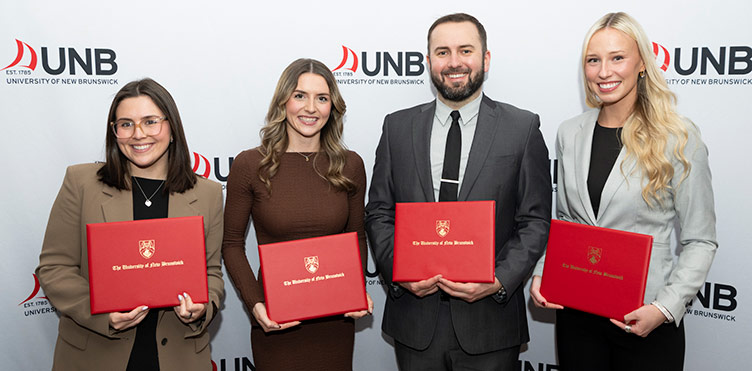
This year, four graduating students are being recognized for embodying that ideal at the highest level. Julia Evans, Jami Horne, Bernard Morgan, and Laura Pitts have been inducted into the Sir Howard Douglas Society, one of the University’s most distinguished student honours. Named for Sir Howard Douglas, whose leadership helped shape the early foundations of the University of New Brunswick, the Society recognizes students who exemplify academic excellence, leadership, and community engagement. Its motto—Non Nobis Solum, or Not for Ourselves Alone—speaks to a vision of education rooted in service and shared responsibility.

Julia Evans (JD’26), from Grand Bay-Westfield, New Brunswick, says receiving the Sir Howard Douglas Scholarship was especially meaningful because it recognized not only academic achievement, but also the importance of leadership and community involvement throughout law school.
“Law school can be very achievement-oriented, so this award felt like a reminder that how you contribute to the people around you matters just as much,” she says. “I am incredibly proud of my academic achievements, but there is something especially meaningful about recognition that also reflects community involvement and leadership.”
Throughout her time at UNB Law, Evans immersed herself in opportunities that combined advocacy, collaboration, and service. One experience that stands out was helping organize the Law Needs Feminism Because… conference, an event she describes as both rewarding and deeply impactful.
“It was the culmination of so much hard work from our executive team, and it was incredibly rewarding to see it all come together,” she says. “What I remember most was being able to step back during the event and appreciate the speakers, conversations, and community we had created together. The conference encouraged thoughtful and sometimes difficult discussions, but most importantly, it brought people together.”
Evans says some of the most important lessons she learned at UNB Law extended beyond the classroom.
“You are only a law student for three years, but you are colleagues for much longer than that,” she says. “I wanted to learn early on how to navigate the competitive spirit of law school while still maintaining strong relationships and a sense of community before entering the profession full-time.”
She credits much of her growth to the mentorship and support she received from faculty, classmates, and teammates along the way.
“I have been incredibly fortunate to have such supportive professors and mentors at UNB Law,” she says. “From Professor Matyas cheering me on throughout the clerkship application process to Professor Bowley stepping in to write a last-minute recommendation letter for me, I always felt genuinely supported and encouraged.”
Her experiences on the Jessup and Gale moot teams also played a major role in shaping her confidence and approach to advocacy.
“Mooting taught me so much about advocacy and teamwork, but it also showed me the importance of trust and supporting one another under pressure,” she says.
Outside the law school, Evans has also remained closely connected to the Sweet Caroline Foundation, an organization founded in memory of her relative, Caroline, who died from anaphylactic shock in 2014. As Secretary of the Board, Evans has contributed to governance initiatives and event planning in support of the Foundation’s mission of allergy awareness and education.
Looking ahead, Evans hopes to use her legal education in a way that is grounded in both compassion and service.
“I hope to use my legal education to empower people, help break down barriers, and be a steady source of guidance during stressful or uncertain moments in their lives,” she says. “More than anything, I hope to build a reputation for being respectful, dependable, and genuinely committed to helping others. I want to be a lifelong learner.”

For Jami Horne (JD’26), law school has always been connected to something larger than individual accomplishment. Originally from Windsor, Nova Scotia, Horne quickly immersed herself in both the academic and community life of the faculty. Her work has focused heavily on accessibility, equity, and disability advocacy—areas she describes not simply as interests, but as commitments rooted in lived community experience.
As a board member with Inclusion Fredericton, she has worked on issues relating to inclusive housing, education supports, and community planning. Nationally, she serves as a disability case monitor for Pro Bono Students Canada in partnership with Inclusion Canada, contributing legal research that informs disability-rights advocacy across the country.
At UNB Law, she has also helped shape student life directly, serving as co-president of the Health Law Society, vice-president and founding member of the Fertility Law Society, and founder of Youth LEAD, a mentorship initiative supporting youth with disabilities.
Still, Horne speaks less about achievement than about responsibility.
“Receiving the Sir Howard Douglas Scholarship was incredibly meaningful because it felt like a recognition of everyone who helped me get here,” she says. “I have been shaped by communities that believed in me, challenged me, and made space for me long before I fully knew what I wanted to do.”
That perspective mirrors the Society’s motto closely: Non Nobis Solum: Not for Ourselves Alone
“That idea reminds me that achievement should lead us back to community,” she says. “When we have the ability, privilege, or education to help, I believe we have a responsibility to use it.”
For Horne, pro bono work became one of the clearest expressions of that belief.
“One of the most meaningful parts of my time at UNB Law has been volunteering with Pro Bono Students Canada in partnership with Inclusion Canada,” she explains. “Legal education is a privilege, and pro bono work is one way to turn that privilege outward.”
Her commitment to community involvement, she says, also became a way of navigating the intensity of law school itself. It provides perspective and keeps her connected to something bigger than grades and exams.
“Community involvement is what keeps me grounded during my studies,” she says. “During the hardest parts of the semester, community work reminds me, in a very real way, why I am here and who this education can serve.”
Along the way, mentors helped shape her approach to advocacy and leadership.
“Professor Paul Warchuk has had a particularly lasting impact on me,” she says. “I have taken classes with him every year of law school, and he also coached my competitive moot team. He is brilliant, kind, and incredibly supportive.”
The experience reinforced something Horne says she felt from the moment she arrived at UNB Law: that even within a demanding academic environment, community and collegiality matter.
“UNB Law may be small,” she says, “but it is mighty. And students here are doing work that stands proudly alongside any law school in the country.”

For Bernard Morgan (JD’26), the path to law school looked a bit different than most. Originally from St. John’s, Newfoundland and Labrador, Morgan arrived at UNB Law after a previous career, bringing with him leadership experience shaped in part by his time as a police officer. Returning to school, he says, was both exciting and daunting.
“I was drawn to UNB because of its strong reputation in Atlantic Canada and the collegial nature of the law program,” he says. “Particularly, I was drawn to a school that would not only allow, but encourage me to get involved.”
He found exactly that.
Throughout law school, Morgan became deeply involved in student governance and mentorship. As chair of the UNB Student Disciplinary Committee, he worked to ensure disciplinary processes remained grounded in fairness and natural justice. He also served on the Faculty Articling and Placement Committee, helping fellow students navigate the stresses of recruitment and professional development.
“A lot of my involvement came from wanting to use my past experiences to help others,” he explains.
That practical perspective shaped how he approached leadership.
“With the Student Disciplinary Committee, it was important to separate how the student discipline code is about course correction and not punitive action,” he says. “Hopefully that approach helps young adults learn from, instead of be haunted by, their mistakes.”
Morgan also volunteered with Innocence Canada through Pro Bono Students Canada, contributing to efforts focused on wrongful convictions and access to justice.
Receiving the Sir Howard Douglas honour, he says, carried special meaning given the non-traditional route that brought him to law school.
“It was a genuine privilege to be recognized with some other outstanding award winners,” he says. “As someone who returned to law school after a previous career, I was very proud to be recognized for transforming my past experiences into academic success.”
That connection between lived experience and legal education became central to his time at UNB.
“UNB Law really values experiential learning and practicality,” he says. “I was able to succeed by relying on that lived experience.”
Morgan points repeatedly to collegiality as the defining characteristic of the faculty.
“It was never a competition here,” he says. “People always looked out for and supported one another. The Sir Howard Dogulas motto, to me, really emphasizes the importance of community. That is one of the strengths at UNB law—whether it’s sharing notes from missed classes, or peer study sessions, the law school community is strongest together. It’s the Dean offering lunch time advice sessions during my 1L year; professors having an open-door policy; classmates sitting around the library bouncing ideas off each other. I think the UNB environment really ensures that anyone who is willing to get involved and stay engaged will experience academic and personal growth.”
Academically, Morgan gravitated toward international humanitarian law, the law of armed conflict, and energy law—subjects he says feel increasingly urgent in a period of global instability.
“UNB’s diverse course offerings allowed me to really dive into complex and personally stimulating issues,” he says.
Looking ahead, Morgan plans to begin his career in employment law while continuing to pursue opportunities connected to military through a reserve legal officer (JAG) position with the Canadian Armed Forces.
“There is really little that has a greater impact on a person’s life than their employment. I am working on the employer side, but my experience at UNB has taught me that the law is about more than words, or cases. It’s also about people. I hope to take a collegial and human approach to that aspect of law.”

For Laura Pitts (JD’26), community engagement and criminal justice reform have become deeply intertwined.
Originally from Beaver Bank, Nova Scotia, Pitts says she knew from high school that she wanted to study law. What drew her to UNB, however, was the sense of connection she felt the school offered.
“What drew me most was the school’s close-knit community and the opportunity to learn in an environment where students and professors are genuinely connected,” she says.
That environment, she explains, exceeded expectations.
“I’ve built lasting friendships and developed meaningful relationships with professors that I don’t think would have been possible at a larger school.”
At UNB Law, Pitts became a familiar presence across student leadership and extracurricular initiatives. She served as co-chair of the annual Charity Auction, co-president of the Criminal Law Society, and 3L representative on the Articling and Placement Committee.
Her work beyond the faculty has been equally significant. For the past four years, Pitts has served on the board of directors for the 7th Step Society of Nova Scotia, including two years as vice-chair, helping support reintegration and rehabilitation efforts for individuals transitioning from incarceration.
Those interests naturally informed her work within the law school as well.
As co-president of the Criminal Law Society, Pitts helped organize UNB Law’s first-ever criminal law conference this year—an event designed to bring together lawyers, judges, community organizations, and individuals with lived experience.
“The conference aimed to bring together individuals from across the justice system, including those with lived experience, to understand the gaps in the system and how it can be improved,” she says.
Receiving the Sir Howard Douglas recognition, she says, helped validate the broader dimensions of her law school experience.
“Law school can often come with a sense of imposter syndrome,” she says. “So being recognized not only for academic achievement but also for involvement beyond the classroom was very affirming.”
One of the experiences she credits most strongly with shaping her development was competitive mooting.
“Without question, participating in the competitive moot program at UNB Law has had the most significant impact on my growth, both academically and personally,” she says.
Working alongside professors like Professor Greg Bowley and Professor Benjamin Perryman during intensive moot preparation strengthened not only her advocacy skills, but also her confidence under pressure.
“Balancing the demands of intensive competition preparation alongside coursework and other extracurricular commitments was challenging,” she says, “but ultimately made the experience even more rewarding.”
For Pitts, staying involved outside the classroom became essential to maintaining balance during law school.
“I’ve found being involved in activities I genuinely enjoy provides a valuable break from academic work and ultimately makes me more productive,” she says.
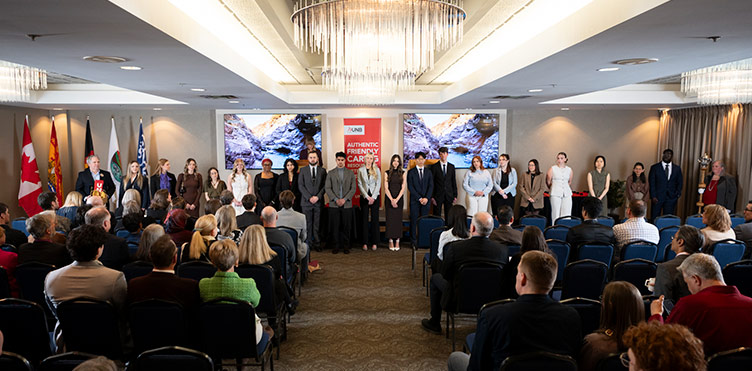
Although their interests differ—disability advocacy, public service, criminal justice reform, mentorship—all four recipients speak about success in remarkably similar terms. None describe law school primarily through grades, awards, or competition. Instead, they return repeatedly to community: the professors who mentored them, the classmates who supported them, the organizations they served, and the responsibility that comes with legal education itself.
At a time when legal education can often feel defined by pressure, recruitment cycles, and individual achievement, the Sir Howard Douglas Society offers a different measure of success: one rooted in service, generosity, and contribution. For these students, the recognition arrives not simply as an award at the end of law school, but as a reflection of how they moved through it.