Stefanie Hunt-Kennedy

Professor of History
PhD
MMFC 211 and Tilley Hall 115
Fredericton
Other titles
Director of the Muriel McQueen Fergusson Centre for Family Violence Research
Research interests
Histories of the Caribbean, Atlantic World, and Vast Early Americas; disability and madness; slavery and emancipation; race, gender, and sexuality; poverty; law.
Biography
Stefanie Hunt-Kennedy is a Professor of History and Director of the Muriel McQueen Fergusson Centre at the University of New Brunswick. Her research and teaching focus on histories of slavery and emancipation, race, gender, disability, and madness in the Caribbean, Atlantic World, and vast early Americas.
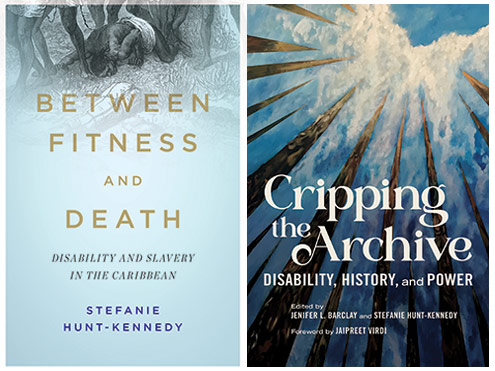
Hunt-Kennedy is the author of the award-winning book, Between Fitness and Death: Disability and Slavery in the Caribbean (University of Illinois Press, 2020), which received the 2021 Disability History Association’s Outstanding Book Award. Her second book, Cripping the Archive: Disability, History, and Power, co-edited with Jenifer Barclay, was recently published in the University of Illinois’s cutting-edge Disability Histories Series.
Dr. Hunt-Kennedy is the creator and primary investigator of The Laws of Enslavement and Freedom in the Anglo-Atlantic World, a SSHRC-funded open-access digital archive of the laws governing slavery and emancipation in the Anglo-Atlantic World, from the seventeenth to the nineteenth centuries.
In 2025, Hunt-Kennedy became the Director of the Muriel McQueen Fergusson Centre for Family Violence Research (MMFC), an interdisciplinary research centre committed to collaborative, action-oriented, and community-based research aimed at eliminating family violence and gender-based violence. Stefanie is particularly interested in examining the intersections between disability and intimate partner violence and family violence.
Dr. HK welcomes graduate students interested in histories of disability, race and gender, slavery and emancipation in the Caribbean, Atlantic World, and vast early Americas. She also welcomes students in pursuing research projects in Disability Studies through the Interdisciplinary Studies Program.
Stefanie Hunt-Kennedy is a Series Editor for the University of Illinois Press’s Disability Histories Series. She also serves on the Council for the Omohundro Institute of Early American History & Culture and on the Editorial Board for the William & Mary Quarterly.
Education
- PhD, University of Toronto, 2015
- MA, University of Guelph, 2009
- BA, Trent University, 2008
Representative publications
Between Fitness and Death: Disability and Slavery in the Caribbean (University of Illinois Press, 2020). *Winner of the 2021 Disability History Association Outstanding Book Award.
Cripping the Archive: Disability, History, and Power (editor with Jenifer Barclay) (University of Illinois Press, 2025).
“Defining Poverty,” in A Cultural History of Poverty at the Dawn of the World Economy (1450 –1650) (Bloomsbury Publishing, 2025).
“’Had it not been for her:” Disability, Gender, and Care Labor in the Age of Amelioration,” Gender & History (2023) 1–15.
“Disability in the Archive of Slavery,” in Early Modern Medicine: A Source Centered Introduction edited by Olivia Weisser (Routledge, 2023).
“Disability, the Middle Passage, and the Plantation: Slavery-Induced Disability in the Eighteenth-Century Caribbean,” Disability Histories: Local, Global and Colonial Stories (edited by Esme Cleall) (Routledge, 2023).
“Silence, Violence, and the Archive of Slavery,” English Language Notes, (59.1, April 2021): 222-224.
“‘Had his nose cropt for being formerly runaway:” Disability and the Bodies of Fugitive Slaves in the British Caribbean,” Slavery & Abolition: A Journal of Slave and Post-Slave Studies, 41:2 (2020), 212-233. *Winner of the Disability History Association’s Outstanding Journal Article 2021; *Honourable Mention for the Andrés Ramon Mattei-Neville Hall Article Prize in recognition of excellence in the field of Caribbean history.
“The Haunting of Slavery: Colonialism and the Disabled Body in the Caribbean,” with Melanie J. Newton in Disability in the Global South: the Critical Handbook, eds. Shaun Grech and Karen Soldatic (New York: Springer Publishing Company, 2016), 379-391.
“Let them be young and stoutly set in limbs:” Race, Labor, and Disability in the British Atlantic World,” Social Identities Special Issue: Disability and Colonialism: (Dis)encounters and Anxious Intersectionalities 21, no. 1 (2015), 37-52. Reprinted in Routledge Historical Resources: 19th Century Empire.