
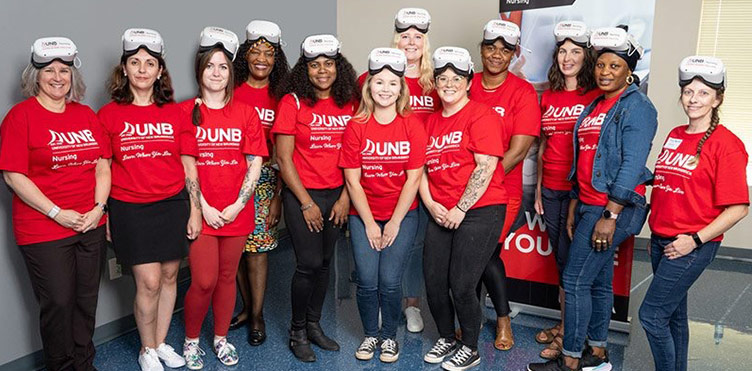
The Learn Where You Live (LWYL) Program is an innovative initiative by the University of New Brunswick’s Faculty of Nursing designed to expand access to nursing education in underserved and rural communities, including Miramichi and Moncton. The program enables students to complete high-quality nursing education in their home regions, helping address workforce shortages while strengthening community-based healthcare capacity.
LWYL delivers a distributed nursing education model that combines local clinical placements, remote learning, simulation-based training, and strong partnerships with regional healthcare providers. Students benefit from hands-on experience in their own communities while maintaining academic alignment with UNB’s nursing curriculum and standards.
To enhance experiential learning where in-person exposure may be limited, the program integrates simulation and emerging tools such as VR to support consistent, high-quality clinical training across all sites.
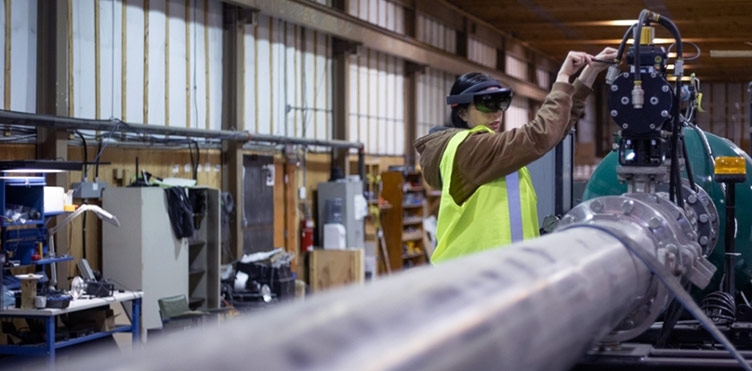
This project focuses on developing a cutting-edge environmental digital twin to enhance decision-making in port environments across Atlantic Canada. The system integrates both traditional and next generation sensing technologies to gather environmental and operational data in real time.
The collected data feeds into a numerical ocean physics model, which then powers AI and machine learning models to generate accurate forecasts, risk analyses, and sustainability insights. These outputs are shared with port authorities and key stakeholders to guide operations and planning.
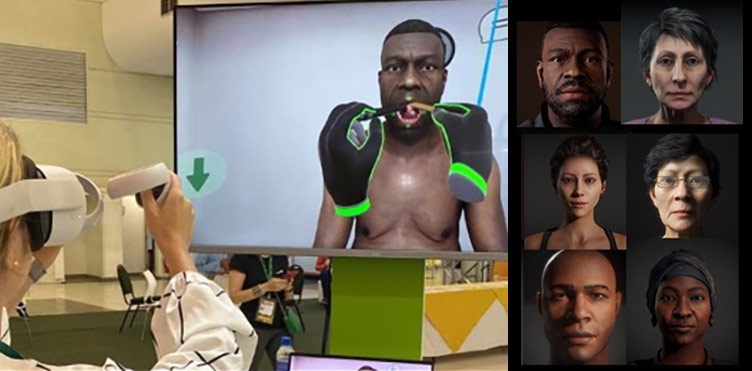
The Custom VR for Nursing project uses immersive virtual reality (IVR) to transform how undergraduate nursing students learn safe medication administration. Through realistic, interactive simulations, students can practice complex clinical procedures in a risk-free, fully immersive environment, improving both confidence and competence before entering real-world clinical settings.
The IVR platform recreates authentic healthcare scenarios — from medication preparation to patient interaction — allowing learners to make decisions, experience outcomes, and receive immediate feedback. The project blends cutting-edgespatial computing with evidence-based educational frameworks, ensuring that both the technology and pedagogy work together to maximize learning outcomes.
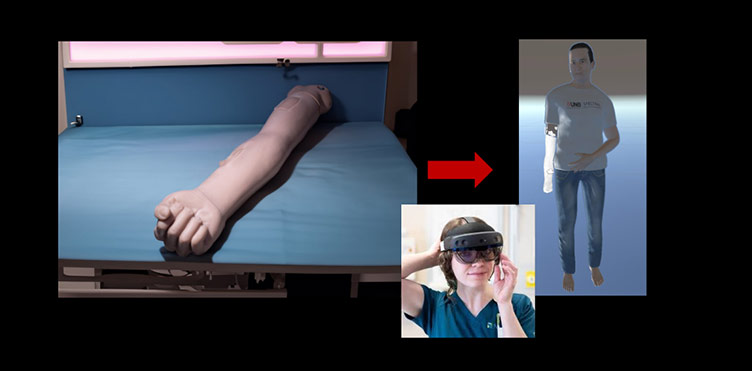
This project aims to develop a Mixed Reality (MR) IV Task Trainer to enhance hands-on medical and nursing education through immersive simulation. Led by UNB SPECTRAL (Spatial Computing Research Centre), the initiative combines physical medical task trainers with augmented and virtual reality to improve intravenous (IV) insertion training in a safe, realistic, and data-rich learning environment.
The solution is designed to improve upon traditional medical task trainers by integrating tactile practice with immersive clinical context, decision-making, and interpersonal skill development.
The system integrates a physical IV training arm with mixed reality on the Meta Quest 3, allowing learners to practice IV insertion using both real-world tactile feedback and virtual patient interaction. Training scenarios can run in mixed reality (passthrough) or fully virtual environments, with customizable patient profiles and room settings.
Learners complete guided or unguided IV insertion scenarios that include:
The virtual patient responds dynamically to learner behavior, simulating emotional reactions, questions, discomfort, and cooperation levels. Scenarios are adjustable to support different difficulty levels, patient personalities, and learning objectives.
Faculty and researchers can use built-in data collection and evaluation tools to support training assessment, usability testing, and academic research.