Planetary and Space Science Centre
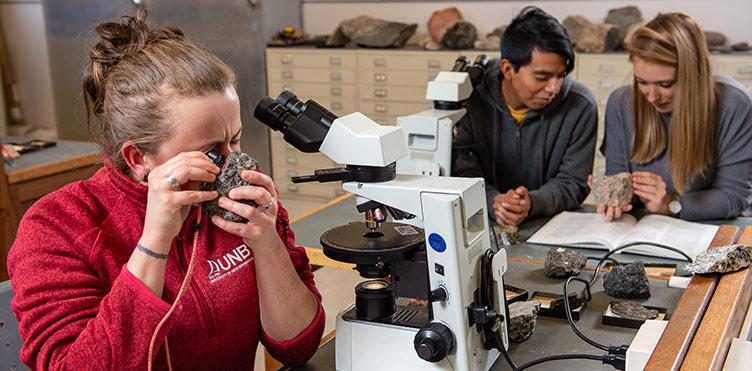
The Planetary and Space Science Centre (PASSC) opened in April, 2001 and was the first facility of its kind in Canada. PASSC is a growing group of scientists and engineers involved in researching planetary geology, space-related technology and associated applications.
PASSC works directly with world-renowned space agencies, including the National Aeronautics and Space Administration (NASA), Canadian Space Agency (CSA) and the European Space Agency (ESA), providing direct involvement with two Mars missions (Mars Science Laboratory and ExoMars). PASSC is affiliated with the Department of Earth Sciences at UNB.
The five main functions of PASSC
Planetary research
The core of PASSC is its research program. The goal is to provide and realize world class training opportunities for undergraduate and graduate students, post-doctoral fellows and senior researchers in science and engineering. Our main areas of activity are investigating planetary materials (including Earth, lunar, martian and asteroid materials), planetary landforms and cratering processes.
Earth impact database
The Earth Impact Database (EID) is a collection of images, publications and abstracts from around the world (compiled over the last 25 years) that provides information about confirmed impact structures for the scientific community and space enthusiasts.
Regional and planetary image facility
The Regional and Planetary Image Facility (RPIF) is one of 17 worldwide NASA-designated facilities providing imagery, maps and data from NASA-led space missions. It is the only one of its kind in Canada. The data is available to scientists, educators, students, media and the general public for the purpose of encouraging and furthering space science studies.
Microanalysis of materials
PASSC is equipped with a micro-Raman spectrometer and has access to a field emission scanning electron microscope, which facilitate the rapid, high precision analysis of planetary, terrestrial and industrial materials.
Outreach and research activities
The Planetary and Space Science Centre is actively involved in outreach programs by members of the Centre to schools or visit the Centre for presentations and workshops. Topics typically include on the Moon, Earth, Mars, other planets of our Solar System and more.
Targets and missions
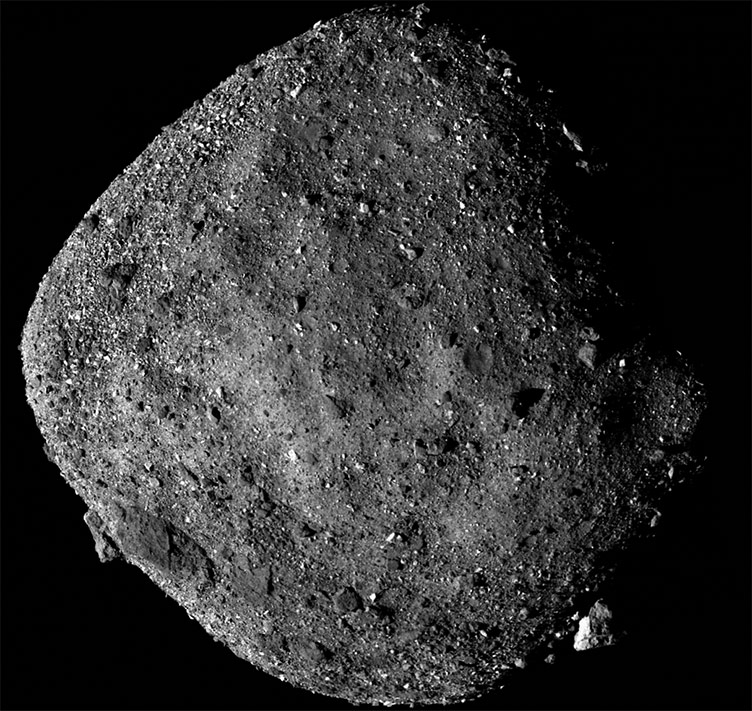
Asteroid Bennu
OSIRIS-REx Mission
Instrument: PolyCam
This mosaic image of asteroid Bennu is composed of 12 PolyCam images collected on Dec. 2 by the OSIRIS-REx spacecraft from a range of 15 miles (24 km).
Image credit: NASA/Goddard/University of Arizona.
Comet 67P Churyumov-Gerasimenko
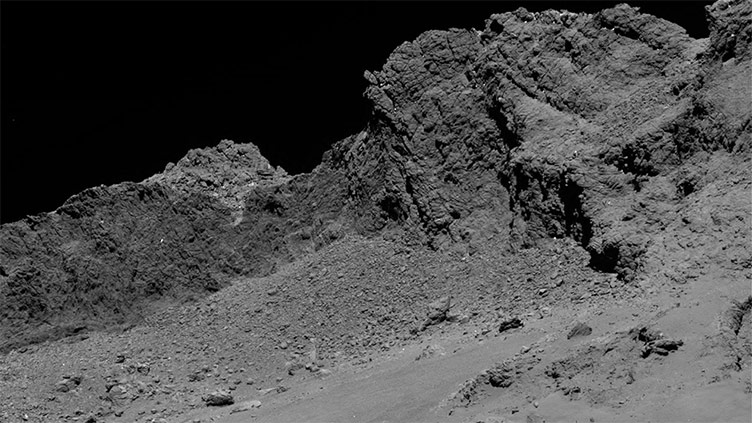
Rosetta, ESA Mission
Instrument: OSIRIS narrow-angle camera
Rosetta’s OSIRIS narrow-angle camera captured this image of Comet 67P/Churyumov-Gerasimenko at 01:20 GMT from an altitude of about 16 km above the surface during the spacecraft’s final descent on Sept. 30.
The image scale is about 30 cm/pixel and the image measures about 614 m across.
Id: 366050
Image credit: ESA/Rosetta/MPS for OSIRIS Team MPS/UPD/LAM/IAA/SSO/INTA/UPM/DASP/IDA
Gale Crater, Glen Torridon and Mars
Mars Science Laboratory, Curiosity Rover Mission
Instrument: Mastcam
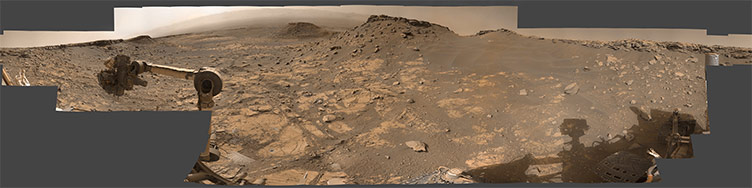
Mastcam 360 degree, 18x7 mosaic taken of Curiosity's surroundings on martian solar day 2671. Curiosity is currently (Feb. 2020) just below the "Greenheugh pediment" analyzing the bedrock below the contact with the pediment capping rock.
Image credit: NASA/JPL-Caltech/NeV-T Space
Mars Science Laboratory, Curiosity Rover and Mars Reconnaissance Orbiter Mission
Instrument: High Resolution Imaging Science Experiment
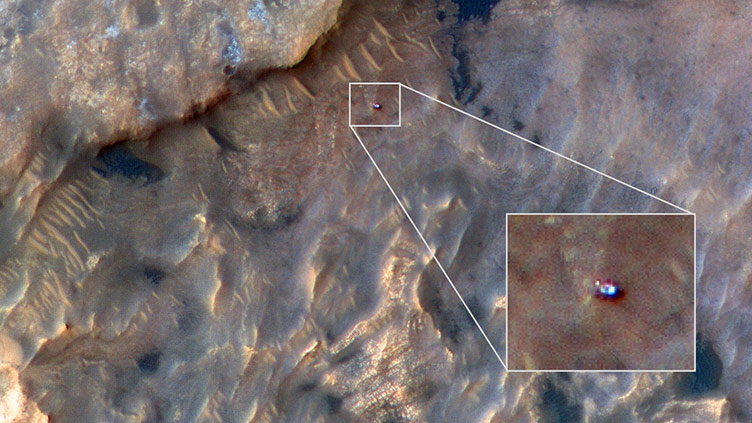
A dramatic martian landscape can be seen in a new image taken from space, showing NASA's Curiosity rover examining a location called "Woodland Bay." It's just one of many stops the rover has made in an area referred to as the "clay-bearing unit" on the side of Mount Sharp, a 3-mile-tall (5-kilometer-tall) mountain inside of Gale Crater.
The image was taken on May 31, 2019, by the High Resolution Imaging Science Experiment (HiRISE) camera aboard NASA's Mars Reconnaissance Orbiter (MRO). In the image, Curiosity appears as a bluish speck. Vera Rubin Ridge cuts across the scene north of the rover, while a dark patch of sand lies to the northeast.
Look carefully at the inset image, and you can make out what it is likely Curiosity's "head," technically known as the remote sensing mast. A bright spot appears in the upper-left corner of the rover. At the time this image was acquired, the rover was facing 65 degrees counterclockwise from north, which would put the mast in about the right location to produce this bright spot.
Mirror-like reflections off smooth surfaces show up as especially bright spots in HiRISE images. For the camera to see these reflections on the rover, the Sun and MRO need to be in just the right locations. This enhanced-color image of Curiosity shows three or four distinct bright spots that are likely such reflections.
Image credit: NASA/JPL-Caltech. Press release images from MSL.
Jupiter
Juno Mission
Instrument: JunoCam
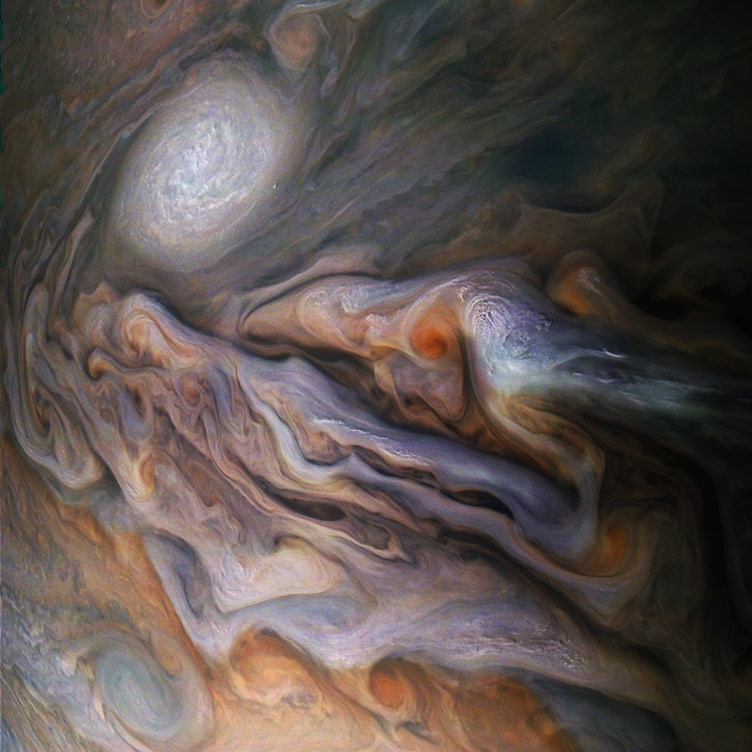
A multitude of swirling clouds in Jupiter's dynamic North North Temperate Belt is captured in this image from NASA's Juno spacecraft. Appearing in the scene are several bright-white and pop-up clouds as well as an anticyclonic storm, known as a white oval.
This color-enhanced image was taken at 4:58 p.m. EDT on Oct. 29, 2018, as the spacecraft performed its 16th close flyby of Jupiter. At the time, Juno was about 4,400 miles from the planet's cloud tops, at a latitude of approximately 40 degrees north.
Image credit: Enhanced image by Gerald Eichstädt and Sean Doran (CC BY-NC-SA) based on images provided courtesy of NASA/JPL-Caltech/SwRI/MSSS
Juno, NASA Mission
Instrument: JunoCam
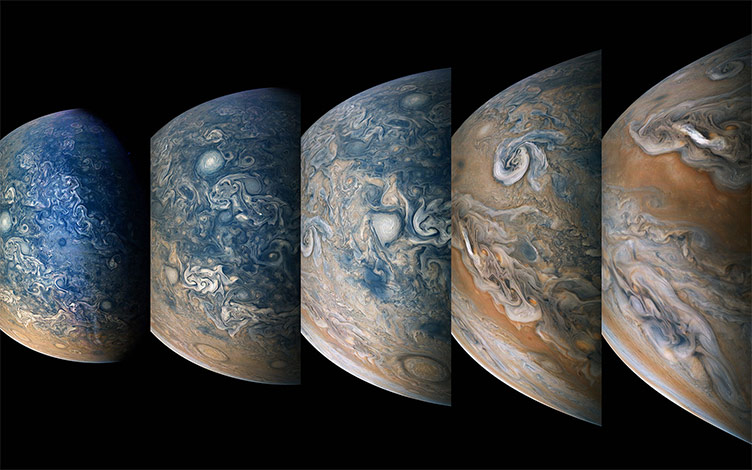
Striking atmospheric features in Jupiter’s northern hemisphere are captured in this series of color-enhanced images from NASA’s Juno spacecraft.
An anticyclonic white oval, called N5-AWO, can be seen at center left of the first image (at far left) and appears slightly higher in the second and third images. A tempest known as the Little Red Spot is visible near the bottom of the second and third images. The reddish-orange band that is prominently displayed in the fourth and fifth images is the North North Temperate Belt.
From left to right, this sequence of images was taken between 9:54 p.m. and 10:11 p.m. PDT on July 15 (12:54 a.m. and 1:11 a.m. EDT on July 16), as the spacecraft performed its 14th close flyby of Jupiter. At the time, Juno’s altitude ranged from about 15,700 to 3,900 miles (25,300 to 6,200 kilometers) from the planet's cloud tops, above a latitude of approximately 69 to 36 degrees.
Citizen scientists Gerald Eichstädt and Seán Doran created this image using data from the spacecraft’s JunoCam imager.
JunoCam's raw images are available for the public to peruse and process into image products.
Image credit: NASA/JPL-Caltech/SwRI/MSSS/Gerald Eichstäd/Seán Doran
Juno, NASA Mission
Instrument: JunoCam
Feature: Jupiterrise
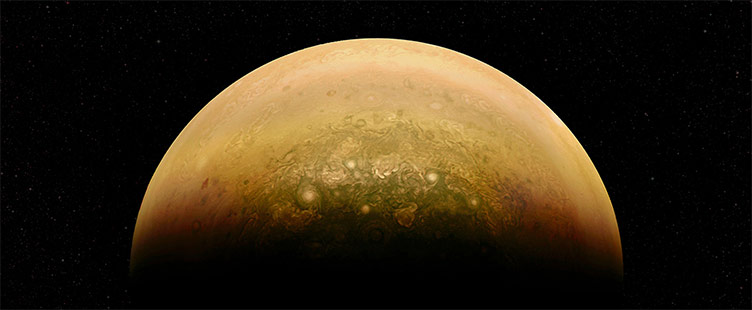
This image of the sunlit part of Jupiter and its swirling atmosphere was created by a citizen scientist (Alex Mai) using data from Juno's JunoCam instrument. JPL manages the Juno mission for the principal investigator, Scott Bolton, of Southwest Research Institute in San Antonio.
Juno is part of NASA's New Frontiers Program, which is managed at NASA's Marshall Space Flight Center in Huntsville, Alabama, for NASA's Science Mission Directorate. Lockheed Martin Space Systems, Denver, built the spacecraft. Caltech in Pasadena, California, manages JPL for NASA.
Image credit: NASA/JPL-Caltech/SwRI/MSSS/Mai. JunoCam's raw images are available for the public to peruse and process into image products.
Mars
Mars Science Laboratory, Curiosity Rover Mission
Instrument: MastCam
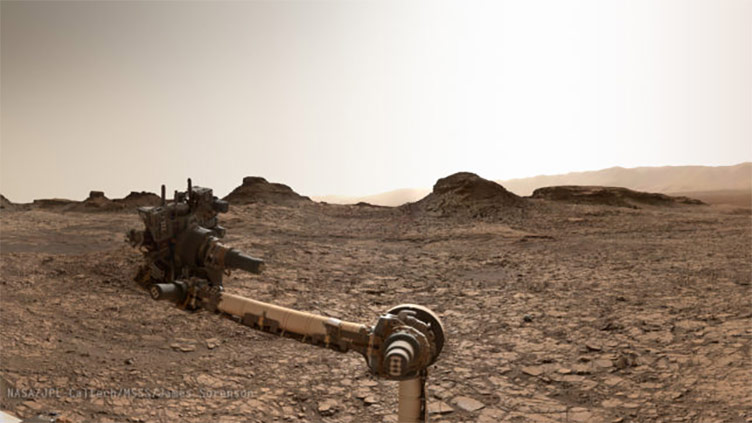
Image Credit: NASA/JPL-Caltech/MSSS/James Sorenson
Feature: Murray Buttes
MSL Curiosity arrives at Murray Buttes at the base of Mount Sharp.
NASA's Jet Propulsion Laboratory, a division of the California Institute of Technology, Pasadena, manages the Mars Science Laboratory Project for NASA's Science Mission Directorate, Washington. JPL designed and built the project's Curiosity rover and its Navcam.
Mars Science Laboratory, Curiosity Rover Mission
Instrument: Navcam
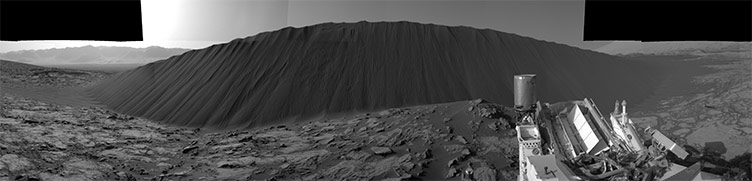
Feature: Slip face on downwind side of 'Namib' sand dune on Mars
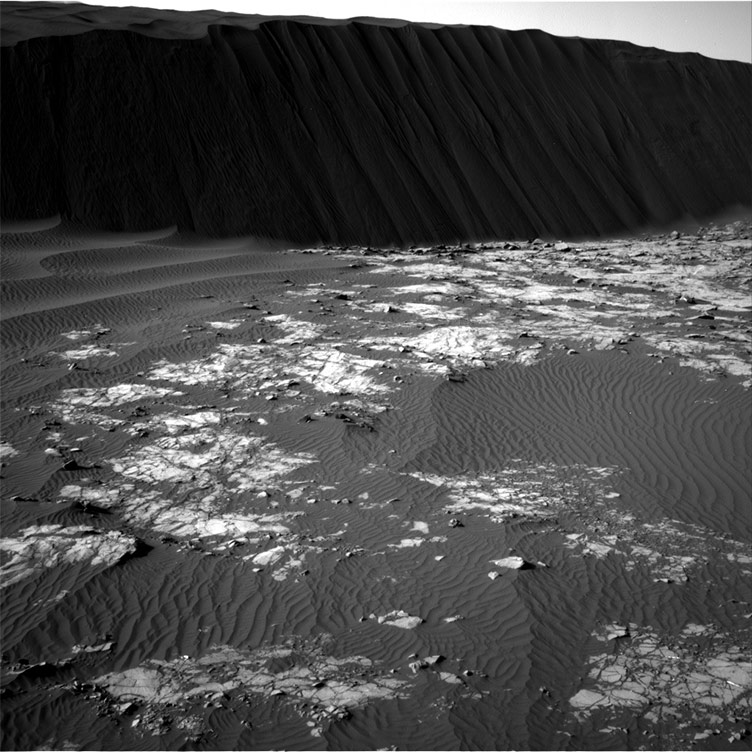
This view from NASA's Curiosity Mars Rover shows the downwind side of "Namib Dune," which stands about 13 feet (4 meters) high. The site is part of Bagnold Dunes, a band of dark sand dunes along the northwestern flank of Mars' Mount Sharp.
The component images stitched together into this scene were taken with Curiosity's Navigation Camera (Navcam) on Dec. 17, 2015, during the 1,196th Martian day, or sol, of the rover's work on Mars. In late 2015 and early 2016, Curiosity is conducting the first up-close studies ever made of active sand dunes anywhere but on Earth. Under the influence of Martian wind, the Bagnold Dunes are migrating up to about one yard or meter per Earth year. The view spans from westward on the left to east-southeastward on the right. It is presented as a cylindrical perspective projection.
The downwind, or lee, side of the dunes displays textures quite different from those seen on other surfaces of the dunes. Compare this scene, for example, to a windward surface of nearby "High Dune" from three weeks earlier. As on Earth, the downwind side of a sand dune has a steep slope called a slip face. Sand grains blowing across the windward side of a dune become sheltered from the wind by the dune itself. The sand falls out of the air and builds up on the lee slope until it becomes steepened and flows in mini-avalanches down the face.
NASA's Jet Propulsion Laboratory, a division of the California Institute of Technology, Pasadena, manages the Mars Science Laboratory Project for NASA's Science Mission Directorate, Washington. JPL designed and built the project's Curiosity rover and its Navcam. Image credit: NASA/JPL-Caltech
Moon
Chang'E-4, Yutu 2 Mission
Instrument: Lunar Penetrating Radar (LPR)
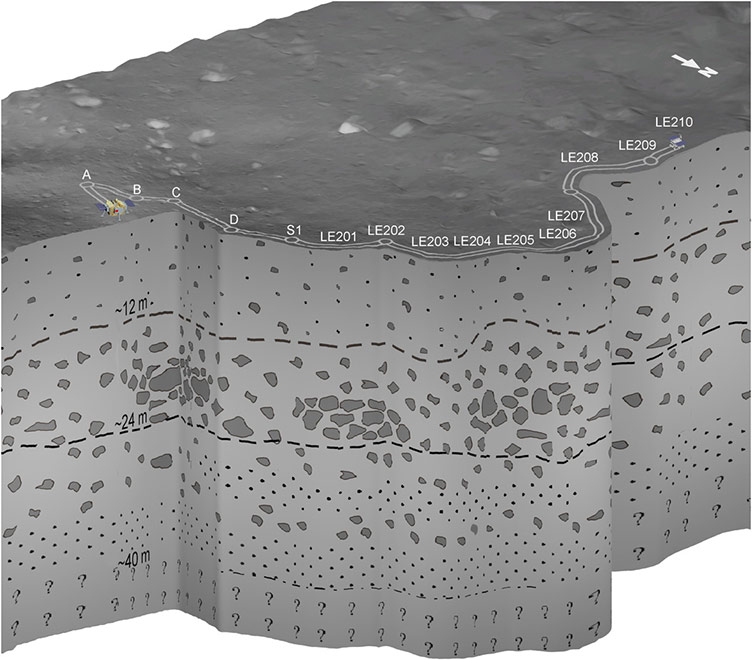
Schematic representation of the subsurface geological structure at the ChangE-4 landing site inferred from LPR observations. The subsurface can be divided into three units: Unit 1 (up to 12 m) consists of lunar regolith, unit 2 (depth range, 12 to 24 m) consists of coarser materials with embedded rocks, and unit 3 (depth range, 24 to 40 m) contains alternating layers of coarse and fine materials.
Image credit: Chunlai Li, et al., 2020. The Moon’s farside shallow subsurface structure unveiled by Chang’E-4 Lunar Penetrating Radar, Science Advances Vol. 6, no. 9, eaay6898
DOI: 10.1126/sciadv.aay6898.
Chang'E 3, Chinese Space Agency Mission
Instrument: Yutu rover and panoramic camera
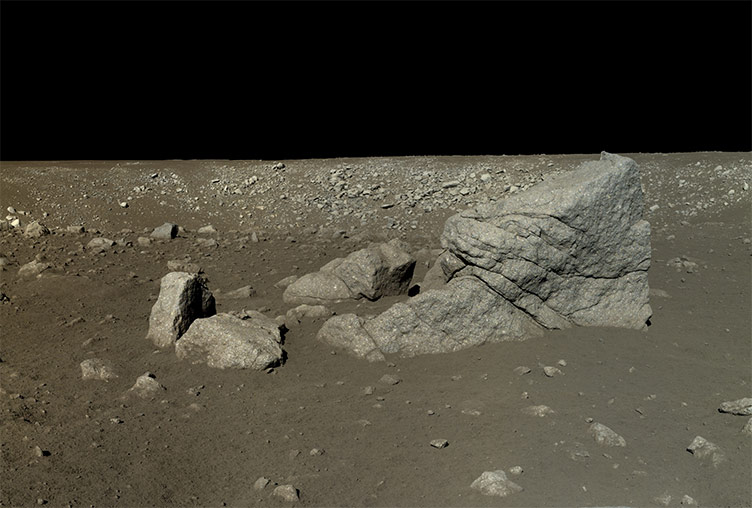
This is a mosaic of six images captured by the Yutu rover on Jan. 13, 2014, after it had driven southwest of the lander to visit a large block of impact ejecta that the team named Long Yan (Pyramid Rock).
Image credit: Chinese Academy of Sciences / China National Space Administration / The Science and Application Center for Moon and Deepspace Exploration / Emily Lakdawalla
Pluto
New Horizons, NASA Mission
Feature: The mountainous shoreline of Sputnik Planum
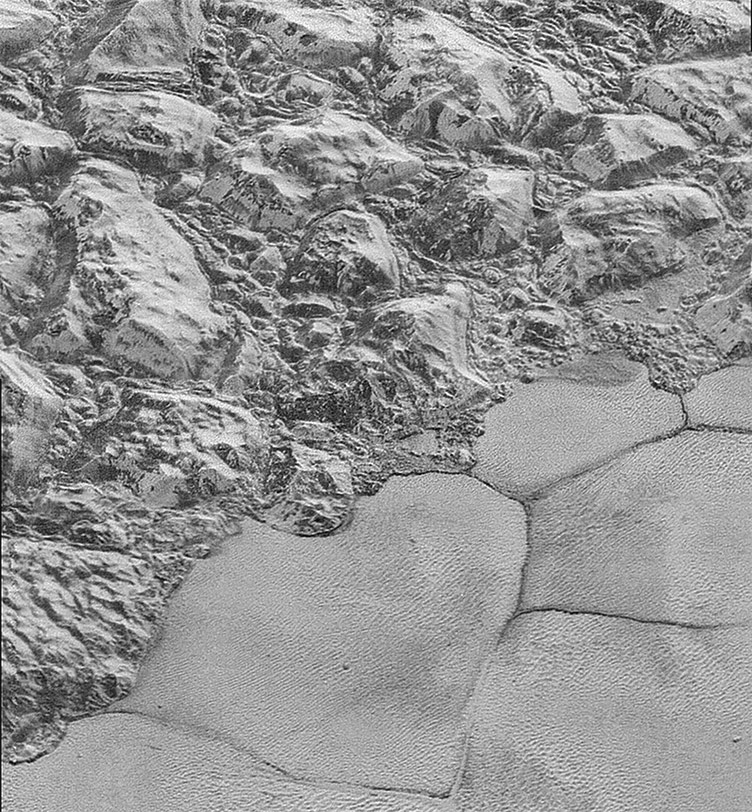
In this highest-resolution image from NASA’s New Horizons spacecraft, great blocks of Pluto’s water-ice crust appear jammed together in the informally named al-Idrisi mountains. Some mountain sides appear coated in dark material, while other sides are bright. Several sheer faces appear to show crustal layering, perhaps related to the layers seen in some of Pluto’s crater walls.
Other materials appear crushed between the mountains, as if these great blocks of water ice, some standing as much as 1.5 miles high, were jostled back and forth. The mountains end abruptly at the shoreline of the informally named Sputnik Planum, where the soft, nitrogen-rich ices of the plain form a nearly level surface, broken only by the fine trace work of striking, cellular boundaries and the textured surface of the plain’s ices (which is possibly related to sunlight-driven ice sublimation). This view is about 50 miles wide. The top of the image is to Pluto’s northwest.
Image credit: NASA/JHUAPL/SwRI
Saturn
Cassini-Huygens, NASA, ESA, Italian Space Agency Mission
Instrument: Wide-angle camera
Feature: Tehtys tops Saturn
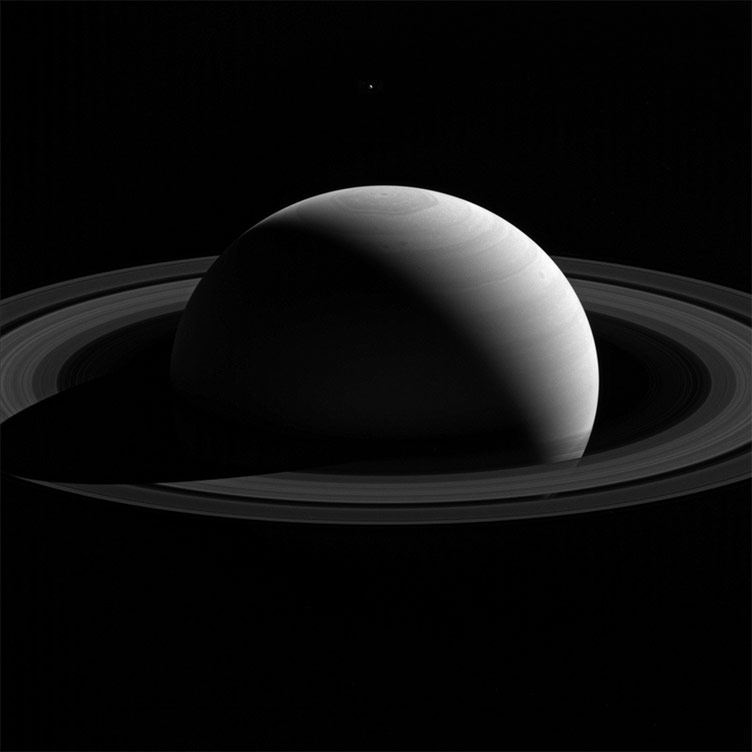
An illusion of perspective, Saturn’s moon Tethys seems to hang above the planet's north pole in this view from NASA's Cassini spacecraft. Tethys (660 miles or 1,062 kilometers across) is actually farther away than Saturn in this image. Lacking visual clues about distance, our brains place the moon above Saturn's north pole. Tethys, like all of Saturn's major moons and its ring system, orbits almost exactly in the planet's equatorial plane.
This view looks toward the sunlit side of the rings from about 17 degrees above the ring plane. The image was taken with the Cassini spacecraft's wide-angle camera on Jan. 26, 2015 using a spectral filter which preferentially admits wavelengths of near-infrared light centered at 752 nanometers.
The view was acquired at a distance of approximately 2.1 million miles (3.4 million kilometers) from Saturn. Image scale on Saturn is 120 miles (200 kilometers) per pixel. Tethys has been brightened by a factor of three relative to Saturn to enhance its visibility.
The Cassini mission is a cooperative project of NASA, ESA (the European Space Agency) and the Italian Space Agency. The Jet Propulsion Laboratory, a division of the California Institute of Technology in Pasadena, manages the mission for NASA's Science Mission Directorate, Washington. The Cassini orbiter and its two onboard cameras were designed, developed and assembled at JPL. The imaging operations center is based at the Space Science Institute in Boulder, Colorado.
Image credit: NASA/JPL-Caltech/Space Science Institute
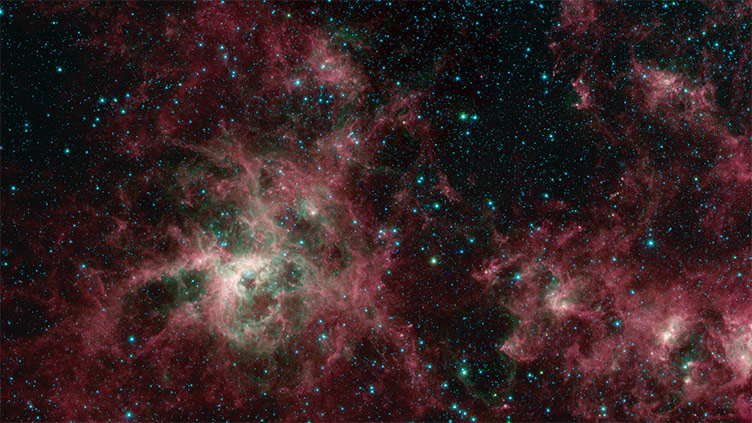
Tarantula Nebula
Spitzer Space Telescope Mission
This image from NASA's Spitzer Space Telescope shows the Tarantula Nebula in three wavelengths of infrared light, each represented by a different color. The magenta-colored regions are dust composed of molecules called polycyclic aromatic hydrocarbons (PAHs), which are also found in ash from coal, wood and oil fires on Earth.
PAHs emit in multiple wavelengths. The magenta color is a combination of red (corresponding to an infrared wavelength of 8 micrometers) and blue (3.6 micrometers). The green color shows the presence of particularly hot gas emitting infrared light at a wavelength of 4.5 micrometers. The stars are mostly a combination of green and blue. White hues indicate regions that radiate in all three wavelengths.
The Tarantula Nebula was one of the first targets studied by the infrared observatory after its launch in 2003, and the telescope has revisited it many times since. Spitzer retired on Jan. 30, 2020, scientists have generated a new view of the nebula from Spitzer data.
Image credit: NASA/JPL-Caltech